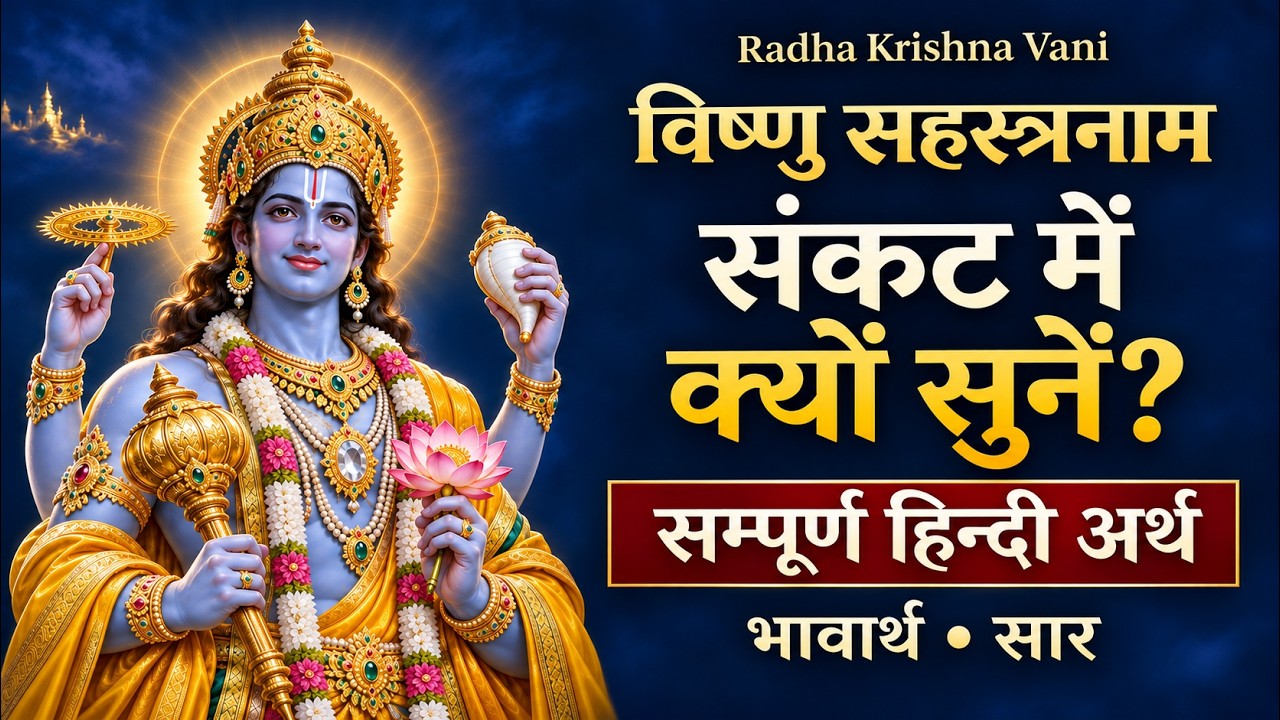

Gopal Sahasranam Fast Path | Arth Sahit Sampurna | Hindi Lyrics | Santan Prapti
- Published:
- Updated:
- Reviewed:
- 14 November 2026
Original verse
The original verse is shown in its source language.
Group 1 — The First Names — Oṁ, Klīṁ and the Creator of the World
Translation
The Lord in the form of Oṁ and Klīṁ, the God of divine love, the crest-jewel of the Kāma-bīja, Shri Gopala — is the protector of the earth and the knower of all the Vedāṅgas. He is the sustainer of the earth, blessed, the white-lotus form, eternal, the Lord of cows and of the earth, the ruler, the striker, and facing in all directions. He is the original creator of creation, the great doer, Mahākāla, mighty, the life of the world, the holder of the world, its sustainer and its support.
Explanation
The thousand names begin with the seed-mantras Oṁ and Klīṁ, and then describe the Lord as creator, sustainer and the all-pervading support of the world.
Summary
Shri Gopala is the original creator, sustainer and support of creation.
Group 2 — The Avatāra Forms and the Lord of Gokula
Translation
He is the Matsya form, fearsome and mighty, subtle, the lord of Kuhū (the new-moon night), the remover, the bearer of the Varāha form, Nārāyaṇa, Ṛṣīkeśa, Govinda and Garuḍa-dhvaja. He is the Lord of Gokula, the moon of the earth, the one who makes the night beloved, lotus-faced, restless-eyed, the white-lotus form and the giver of good.
Explanation
The Lord in His Matsya and Varāha avatāras is the same as the cool, lotus-faced, restless-eyed Gopala of Gokula.
Summary
In His avatāras too, He is the same Gopala who is the Lord of Gokula.
Group 3 — Govinda and the Form of the Gopas
Translation
He is Durvāsā, Kapila and Bhauma (the son of the earth), the confluence of river and ocean, Govinda, the Lord of the gopas, the very form of the clan (gotra), and full of love for the Yamunā. He is the Lord of the gopas, the master of Gokula, the giver of boons on Govardhana, the protector of Nanda and the residents of Gokula, the giver, and the remover of poverty. He is the giver of all auspiciousness, the fulfiller of all desires, the original creator, the sustainer of the earth, and born of all the oceans and rivers.
Explanation
Govinda is not only the Lord of the gopas — He is also the protector of the residents of Gokula, their giver, and the remover of their poverty.
Summary
Govinda is the protector of Gokula and the fulfiller of all desires.
Group 4 — The Saviour of Gajendra, the Rāma Form, and the Pride of Indra
Translation
He moves with the grave gait of an elephant, He is the saviour of Gajendra, the desirous one, the store of the divine art of love, spotless like the moon, and His face is beautiful like the bimba fruit, the most excellent of bimba fruits. He is the maker of garlands, He is the doer of mercy, adorned with a voice sweet like the cuckoo, the Rāma form, the wearer of blue garments, the divine one, the plough-bearer, and the crusher of the unruly. He is the breaker of the city of Indra (the thousand-eyed), the destroyer of epidemics, the very form of welfare, most auspicious, the breaker, and Balārāti — the worshipper of Indra.
Explanation
He who saves Gajendra also breaks the pride of Indra — the Lord's mercy and His effulgence walk together.
Summary
Shri Gopala saves the devotee and breaks pride.
Group 5 — The Lord of Rādhā
Translation
He is the giver of husbands to maidens, worthy of being chosen, the very form of Kāmadeva, Nara-Nārāyaṇa, patient, the Lord of the earth, and generous-minded. He is Lakṣmīpati, the store of opulence, full of beauty, the Lord of Lakṣmī, the destroyer of hostile kings, the Lord of Vṛndā, the very form of the clan, the villager, the very form of the abode, Brahman and eternal. He is the lover of Revatī, the Rāma form, beloved, restless-eyed, the very form of the Rāmāyaṇa, blissful Rāma and Lakṣmīpati. He is the form of night, the night itself, Śarva (Śiva), the giver of good everywhere, the worshipper of Rādhā, the worshipper (the accomplished one), and the delighter of Rādhā's heart.
Explanation
Shri Gopala is both Lakṣmīpati and the Lord of Rādhā — opulence and love dwell together in Him.
Summary
Shri Gopala is the Lord of opulence and the beloved of Rādhā.
Group 6 — The Names of Love for Rādhā
Translation
He is full of the joy of Rādhā's love, eager to enchant Rādhā, able to bring Rādhā under His sway, and like a bee on the lotus-heart of Rādhā. He is delighted by Rādhā's embrace, delighted in Rādhā's dance, the delight born of Rādhā, and the giver of the fruit of Rādhā's desire. He is the Lord of Vṛndā, the treasure-store of the koka (cakravāka) birds, the destroyer of the sorrow born of separation, the Lord of the moon, and the breaker of the fierce bow. He is Rāma, the son of Daśaratha, born in the Bhṛgu clan, delighting in the Self, the conqueror of anger, free from delusion, and the destroyer of the darkness of delusion. He is born of Vṛṣabhānu, the very form of feeling, Kāśyapa, the store of compassion, clamorous, the plough and its bearer, and dear to Balarāma.
Explanation
These names of love for Rādhā show that Shri Gopala is as absorbed in the love of Rādhā as Rādhā is in His love.
Summary
The love of Shri Gopala and Shri Rādhā is complete only in each other.
Group 7 — The Sun of Rādhā's Lotus Face, the Son of Rohiṇī, Paraśurāma
Translation
He is the sunlight of the lotus face of Rādhā, effulgent, born of the sun, the moon form, Vidhi (the ordainer), Vidhātā (the creator), Varuṇa, Vāruṇa (of Varuṇa), and dear to Vāruṇī. He is the delighter of Rohiṇī's heart, the son of Vasudeva, strong, the wearer of blue garments, the son of Rohiṇī, the slayer of Jarāsandha, and spotless. He is the serpent form, the fresh-water form, famous, the slayer of heroes, the giver of boons, mighty, the path of the gopas, victory, learned, all-pervading and eternal. He is the acceptor of Paraśurāma's words, the acceptor of boons, the slayer of the jackal, the adviser of Damaghoṣa, the seizer of the chariot, and the Sudarśana form.
Explanation
The Lord is the sun of Rādhā's lotus face, the son of Rohiṇī, and also the one who accepts the words of Paraśurāma — His forms are infinite.
Summary
The forms of Shri Gopala are infinite — in love, in affection, and in dharma.
Group 8 — Dvārakā, the Yamunā, Lakṣmaṇa, Vāmana, the Joy of Yaśodā
Translation
He is the protector of the fame of heroic wives, the destroyer of old age and disease, the knower of the essence of Dvārakā, and the giver of boons to Agni. He is the stopper of the flow of the Yamunā, the blue-garmented Lord, all-pervading, the bow-bearer, the Gaṇeśa form, and the leader of the gaṇas. He is the Lakṣmaṇa form, endowed with auspicious marks, the very form of the goal, the destroyer of the demon clans, the bearer of the Vāmana form, and the one who became a dwarf, the non-dwarf, the rider of Vāmana. He is the son of Yaśodā, the doer, the liberator of Yamalārjuna, the one bound to the mortar, of great glory, named as the one bound by the rope, and peaceful in form.
Explanation
The Lord who knows the essence of Dvārakā is the same who lets Himself be bound to the mortar in Yaśodā's courtyard — this is the sweetness of His līlā.
Summary
He who is the Lord of Dvārakā lets Himself be bound in Yaśodā's courtyard.
Group 9 — Keśava, the Destroyer of Demons, and the Form of Yajña
Translation
He walks in favour of His devotees, Bhagavān Keśava, the wearer of the immovable, the slayer of Keśī, the destroyer of Madhu, the enchanter, and the destroyer of Vṛṣāsura. He is the destroyer of Aghāsura, the giver of liberation to Pūtanā, the playful one with Kubjā, Bhagavān, the cause of Kaṁsa's death, and the great yajña form. He is the Aśvamedha, Vājapeya, Gomeda and Naramedha yajña forms, more beautiful than crores of Kandarpas (Kāmadevas) and cooler than crores of moons. He is radiant like crores of suns, strong like crores of winds, Brahmā, the creator of the universe, and the fulfiller of Lakṣmī's desire.
Explanation
The Lord who destroys demons is also the very form of yajña — His effulgence exceeds crores of suns, and His coolness exceeds crores of moons.
Summary
The effulgence of Shri Gopala exceeds the sun, and His coolness exceeds the moon.
Group 10 — The Lotus Form, Mahāmāyā, the Joy of Sītā, Candrāvalī
Translation
He is the Kamalā form, lotus-eyed, the lover of the lotus face, the wearer of the lotus vow, beautiful like a lotus, and Purandara. He is full of great fortune, the Lord of Mahāmāyā, fierce with pride, the enemy of Tāraka, the protector of the gods, and the frightener of Mārīca. He is dear to Viśvāmitra, the conqueror of the senses, the Rāma form, lotus-eyed, the destroyer of Rāvaṇa's clan, and the giver of boons to Vibhīṣaṇa. He is the giver of joy to Sītā, Rāma, the hero, the builder of the bridge over the ocean, the slayer of Khara and Dūṣaṇa, and the resident of Sāketapurī. He is the lord of Candrāvalī, the shore (the bank), the slayer of Keśī and Kaṁsa, spotless, Mādhava, the destroyer of the Madhu demon, the honey-sweet one, and cool like the moon.
Explanation
The Lord of lotus-like tenderness is also the destroyer of Rāvaṇa's clan and the builder of the bridge over the ocean — Rāma Himself.
Summary
Tenderness and valour dwell together in Shri Gopala.
Group 11 — Wandering in the Forests, the Life-Beloved of Rādhā, the Lotus of Līlā
Translation
He wanders in the Muṅjā forest, the enemy of Dhenukāsura, the son of the earth, wandering in Vaṁśīvaṭa, and the shelter of the Govardhana forest. He belongs to the Tāla forest, the slayer of Śaṅkha in the Bhāṇḍīra forest, merciful to Tṛṇāvarta, and the husband of Rādhā, the daughter of Vṛṣabhānu. He is dear as the very life of Rādhā, attached like a bee to the honey of Rādhā's lotus face, the giver of joy to the gopīs, the knower of destiny, and worshipped by the lotuses of līlā. He is the group of the lotuses of līlā, the delighter of the gopīs' love, the giver of joy, the entertainer, the very form of colour, the coloured one, and the tree of colour (the stage).
Explanation
Gopala, who wanders in the forests, is the life-beloved of Rādhā — His līlā itself is the tree of love, in whose shade the gopīs find joy.
Summary
The līlā of Shri Gopala is itself the tree of love.
Group 12 — Divine Love, the Devotee of Śiva, the Best Among Gods, the Shelter of the Gaṇas
Translation
He is the very form of divine love, the devotee of Kāmārī (Śiva), the ancient Puruṣa, the poet, the Nārada form, Devala, Bhīma, the child form, and the child face like a lotus. He is the form born of the lotus, the witness of Brahmā, the yogī, the giver of boons, the best of sages, the mountain form, the protector of villages, and dear to the river and the wind. He is Padmanābha, the lotus-navelled one, the best among the gods, Brahmā, Rudra, the wearer of the serpent ornaments, the protector of the gaṇas, the Gaṇeśa form, and the controller of the planets. He is the shelter of the gaṇas, the chief of the gaṇas, the holder of the three worlds in His lap, the Lord of the Yādavas, the master of Dvārakā, and dear to Mathurā, the bearer of the burden (Dhurī).
Explanation
He is the devotee of Śiva, the Nārada form, and the shelter of the gaṇas — the Lord is present in every form.
Summary
Shri Gopala is present in every form — in the devotee, in the yogī, and in the gods.
Group 13 — The Bee-Like Enjoyer, the Friend of Arjuna, the Wish-Tree, the Śiva Principle
Translation
He is the bee-like enjoyer, beautifully haired, the protector of the sons of Kuntī, the great yajña form, the giver of boons to the Yamunā, and the giver of boons to Kāśyapa. He is the mighty slayer of Śaṅkhacūḍa, ready to protect the gopīs, the bearer of Pāñcajanya, delightful, the one who delights in the three worlds, the forest-born one, and victory. He is the friend of Phālguna Arjuna, the slayer of Virādha, the life-lord of Rukmiṇī, and dear to Satyabhāmā. He is the Kalpavṛkṣa, the great tree, the gift-giving tree, the great fruit form, the controller like a goad, the god on earth (Bhūsura), the very form of feeling, the bewildering one (Bhrāmaka), effulgent, and Hari. He is simple, eternal, heroic, of the Yadu clan, the very form of the Śiva principle, Pradyumna, the giver of strength, the striker, the destroyer of the daityas, and the Lord.
Explanation
He is the friend of Arjuna and the wish-tree for devotees — friendship and grace are both in Him.
Summary
Shri Gopala is the friend of devotees and their wish-tree.
Group 14 — The Vanamālā, the Sun, Garuḍa, the Rivers, the Nectar Form
Translation
He is greatly wealthy, the great hero, adorned with the Vanamālā, beautified by the Tulasī garland, and the destroyer of Jālandhara. He is the hero, the sun form, the sun Mṛtaṇḍa, Bhāskara, worshipped by the whole world, the sun Ravi, the destroyer of darkness, the fire form, and the submarine fire Vaḍavānala. He is the destroyer of the pride of the daityas, the Garuḍa form, the Aruṇa form, the elder brother of Garuḍa, the Lord of the gopīs, the great Lord, the Lord of Vṛndā, and the non-opposing one. He pervades the whole creation, the five-formed one, present even in creepers and shrubs, Gopatī, the form of the Gaṅgā and Yamunā, the Godā and Vetravatī forms. He is the Kaverī, Narmadā, Tāptī, Gaṇḍakī and Sarayū forms. Endowed with rajas, tamas and sattva, He is yet complete in all limbs and the seer of all. He is the nectar form, Amṛtamaya, the nectar form, dear to the yoginīs, the very form of welfare, the enlightened one (Buddha), the best among the wise, Viṣṇu, victory, and the Indra form. He is the flute-bearer, the bearer of the clan, the world form, the seer of all, the destroyer of delusion, the sound form, the form of sound, the form of strength, and cloud-like.
Explanation
The sun-formed Lord flows also as the Gaṅgā, Yamunā, Kaverī, Narmadā, Tāptī, Gaṇḍakī and Sarayū — every element of creation is His form.
Summary
Every element of creation — river, tree, sun, cloud — is the form of Shri Gopala.
Group 15 — Śiva, Mohinī, Kubjā, the Remover of Sins, the Twelve Forests
Translation
He is Śiva, Rudra, Nala, Nīla, the plough-bearer, the shelter of the plough, pure like mercury, holy, the swan form, the swan-vehicle, and the Lord of the world. He is the enchanter even of Mohinī, the wielder of māyā, the Lord of Mahāmāyā, the great yajña form, the form of dharma, Vṛṣākapi, the form of time, and the subduer of Kāliya. He is the awakener of Kubjā's fortune, the hero, the destroyer of the washerman, the soft Varuṇa form, the king, lotus-born, and the bearer of water. He is the remover of sins, the destroyer of all sins, Parameṣṭhī, Pitāmaha, the sword-bearer, the merciful one, and Rādhā-Ramaṇa Sundara. He plays in the twelve forests, is situated on the hoods of Śeṣanāga, the form of Kāma, dark-complexioned, the giver of happiness and Śrī, Śrīpati, Śrīnidhi and Kṛtiśīla. He is Hari, Nārāyaṇa, the man, the best of men (Narottama), the lover of the bow, the stealer of the gopīs' hearts, and the carrier who ferries souls across the world.
Explanation
He who enchants even Mohinī also awakens Kubjā's fortune and removes sins — the Lord's grace reaches the smallest and the most broken.
Summary
The grace of Shri Gopala reaches the smallest and the most broken.
Group 16 — The Original God, Hayagrīva, the Syamantaka Jewel, Increase
Translation
He is the original God, Mahādeva, the Guru of Gaurī, dependent on none, the sādhu, sweet, the moon (Vidhu), the bearer and protector, and the one merciful to Akrūra. He is the bee (Rolambī), Hayagrīva, the enemy of the monkeys, the one who takes shelter in the forest, the forest form, the forest wanderer, the forest chief, greatly worshippable, and the great sage. He is the knower of the Syamantaka jewel, discerning, the destroyer of obstacles, the Govardhana form, worthy of increase, the giver of increase, and dear to increase. He is worthy of increase, the form of increase, the ever-increasing one, the causer of progress, dear to Sumukha, the grown one, ancient, the aged one (Vṛddha), and dear to the hosts of gods.
Explanation
He who depends on none is also the forest wanderer — and He causes the increase and progress of His devotees.
Summary
Shri Gopala depends on none, yet causes the increase of His devotees.
Group 17 — Gopāla, Vyāsa, the Auspicious Form, Kṛṣṇa the Lotus-Eyed
Translation
He is Gopāla, the Lord of the gopīs, the destroyer of Sāmba's leprosy, the abductor of Rukmiṇī, the very form of love, the loving one, and dear to Candrāvalī. He is the doer of Śrī, the bearer of the world, Nara-Nārāyaṇa, strong, the gaṇa form, Gaṇapati, and the Dattātreya form, the great sage. He is Vyāsa, Nārāyaṇa, the divine splendid form, the bearer of the emotional ones, the very form of welfare, blessed, auspicious, and the doer of future welfare. He is the auspicious form, blessed, the ruler, the supreme ruler, the destroyer of Meghanāda, dear to the brāhmaṇas, and capable of uplifting the poor. He is Kṛṣṇa, lotus-petal-eyed, Kṛṣṇa, lotus-eyed, the very form of love, ever Kṛṣṇa, and dear to all. He is the joy form (Nanda), the giver of joy, greatly blissful, full of sweetness, and intoxicating (Mādanaka). He is the Kilī, Milī, Hilī, Gilī, Golī, Gola, Golālaya and Gulī forms. He is the Guglī, Mārkī, Śākhī, Vaṭa and Pīpala forms, the doer, the destroyer of the mlecchas, the remover of time, and the glory of Yaśodā.
Explanation
Gopāla is also Vyāsa, also the Dattātreya form, and also the lotus-eyed Kṛṣṇa — knowledge, devotion and love are all in Him.
Summary
In Shri Gopala, knowledge, devotion and love are all together.
Group 18 — Keśava Viṣṇu Hari, the Beloved of Jānakī, the Ocean, Kamalāśa
Translation
He is Acyuta, Keśava, Viṣṇu, Hari, the truth form, Janārdana, Haṁsa, Nārāyaṇa, the līlā-filled one, the dark-blue form, and devoted to bhakti. He is dear to Jānakī, Rāma, Virāma, the rest, the destroyer of obstacles, greatly effulgent, greatly luminous, strong-armed, and deep like the great ocean. He is the ocean, the boundless mass of water, the boundless form, the lord of rivers, the giver of joy to Gokula, and the keeper of His vow. He is Sadārāma, Kṛpārāma, Mahārāma, the bow-bearer, the mountain form, mountain-shaped, the Gaya form, worthy of being sung, and dear to the twice-born. He is the Kambalāśvatara form, the Rāma form, the promoter of the Rāmāyaṇa, the sky, the divine world, the day, the divine, the splendid, the fortunate one (Bhāgin), and the remover of fear. He is endowed with the fortune of Pārvatī, the sustainer, aided by Lakṣmī (Lakṣmīsahāyavat), the līlā-filled one, courageous, the all-form, the proud one (Garvī), and glorious-eyed.
Explanation
Keśava, Viṣṇu, Hari — names of one and the same Lord, who is also Rāma, the beloved of Jānakī. The names are many, but the essence is one.
Summary
The names are many, but the essence is one — Shri Gopala.
Group 19 — Murārī, Vaṁchulī, the Lotus-Eyed One, Badrīvana
Translation
He is Murārī, the knower of the dharma of the world, the giver of life, the ender of life, the Yama form, the origin of Yama, the causer of restraint, and the self-ordainer. He is the Vaṁśulī, Pāṁśulī, Dhulī forms, dear to Arjuna, the son of Pāṇḍu, the wearer of the Lalitā-Candrikā garland, the garland-wearer (Mālin), and the shelter of the garland-lotus. He is lotus-eyed, the great Yakṣa, Dakṣa, the source of Cintāmaṇi (Cintāmaṇiprabhava), the jewel, the sun form, and the shelter of Kedāra and Badrī. He is the one pleased in Badrīvana, Vyāsa, the son of Satyavatī, the destroyer of the enemies of the gods, the ocean of nectar, and rising like the moon.
Explanation
He who gives life is also He who ends life — birth and death are both in His hands.
Summary
Birth and death are both in the hands of Shri Gopala.
Group 20 — Moon, Sun, Śiva, Śrīpati, Nārāyaṇa, Bhagavān Gopāla
Translation
He is the moon, the sun, Śiva, the trident-bearer, the discus-bearer, the mace-bearer, the doer of Śrī, Śrīpati, the giver of Śrī, Śrīdeva, and the son of Devakī. He is Śrīpati, lotus-eyed, Padmanābha, the Lord of the world, Vāsudeva, the immeasurable Self (Aprameyātmā), Keśava, and Garuḍa-dhvaja. He is Nārāyaṇa, the supreme abode, the God of gods, Maheśvara, the discus-bearer, full of arts, knowable through the Vedas, and the ocean of mercy. He is Bhagavān, the Lord of all beings, Gopāla, the protector of all, Ananta, Nirguṇa, Nitya, Nirvikalpa and Nirañjana.
Explanation
He is present in the forms of the moon, the sun and Śiva — and He is also the Nirguṇa, eternal, unchanging supreme Lord. The formed and the formless meet in Him.
Summary
The formed and the formless meet in Shri Gopala.
Group 21 — The Supportless One, the Moment-by-Moment Protector, the Womb of Devakī, the Imperishable
Translation
He is supportless, formless, free of appearance, beyond all shelter, the Puruṣa, beyond even Praṇava, Mukunda, and the Supreme Lord. He is the protector moment by moment, the universal sovereign, the Vaikuṇṭha form, the one affectionate to devotees (Bhaktavatsala), Viṣṇu, Dāmodara, Kṛṣṇa, Mādhava, and the Lord of Mathurā. He is manifested from the womb of Devakī, dear to the affection of Yaśodā, Hari, Śiva, Saṅkarṣaṇa, Śambhu, Bhūtanātha and the lord of heaven (Divaspati). He is imperishable, the knower of all dharmas, spotless, free from calamity (Nirupadrava), the hero of liberation, eternal, and beautiful like a dark cloud.
Explanation
He who is supportless and formless manifests from the womb of Devakī and becomes the beloved of Yaśodā's affection — the Supreme Lord Himself comes as a child.
Summary
The Supreme Lord Himself comes as a child — this is the līlā of Gopala.
Group 22 — Beyond the Arts, the Son of Nanda Gopa, Aniruddha, the Wanderer of Vṛndāvana
Translation
He is the presiding lord of the arts (Kalādhyakṣa), all-knowing, ready in the Kamalā form, Ṛṣīkeśa, the wearer of yellow garments, and the dear son of Vasudeva. He is the son of Nanda Gopa, the noble one, the eater of butter, endowed with majesty (Vibhava), the ancient Puruṣa, the foremost (Śreṣṭha), the conch-bearer, and greatly valorous. He is Aniruddha, the discus-bearer (Cakradhara), the bow-bearer, the four-armed one, the mace-bearer, the remover of the gods' pain, Govinda, and the bearer of the Nandaka weapon. He is the wanderer of Vṛndāvana, the hero, expert in flute-playing, the ender of Tṛṇāvarta, greatly courageous, and endowed with many valorous deeds.
Explanation
The butter-eating child is also the heroic wanderer of Vṛndāvana — child play and valour are both in the same Gopala.
Summary
Child play and valour are both in the same Gopala.
Group 23 — Śakaṭāsura, the Grandfather, the Blessed and Honourable, the Ocean of Milk
Translation
He is the destroyer of Śakaṭāsura, the destroyer of Bakāsura, the destroyer of Dhenukāsura, the enemy of Pūtanā, and the Narasiṁha form. He is the grandfather, the Guru, the direct witness, the inner Self, Sadāśiva, the immeasurable Lord, the wise one, beyond logic, and the increaser of dreams. He is blessed, honourable, the Existent One, the very form of feeling, dreadful (to the wicked), peaceful, the world-teacher, the inner dweller, the Lord, divine, the knower of destiny, and praised by the gods. He reclines on the ocean of milk, the bearer, the fortunate one, the elder brother of Lakṣmaṇa, Rāma, the Lord of the earth, the immeasurable Self, and worshipped by Candraśekhara Śiva.
Explanation
The Lord who destroys demons as a child is also the world-teacher and the inner dweller — His essence is hidden in His līlā.
Summary
The Lord's essence is hidden in His child līlā.
Group 24 — The Witness of the World, the Gentle Smile, the Dark Lotus Petal
Translation
He is the witness of the world, the eye of the world, worthy of praise for His holy character, more beautiful than crores of Kāmadevas, and the form that enchants the world. He is whose body bears a gentle smile, surrounded by gopas and gopikās, lotus-eyed like a blooming lotus, and the destroyer of Cāṇūra and Āndhra. He is dark like a blue lotus petal, adorned with a peacock feather, whose flute's call summons the devotees, and covered with divine garlands and garments. He is beautiful-cheeked, beautiful-browed, beautiful-foreheaded, conch-necked, large-eyed, fortunate, and endowed with auspicious marks.
Explanation
The gentle smile of the Lord, more beautiful than crores of Kāmadevas, and the sound of His flute enchant the devotee's heart.
Summary
The Lord's gentle smile and the sound of His flute enchant the devotee's heart.
Group 25 — The Broad Chest, Crown and Earrings, Ankleted Feet
Translation
He is broad-chested, four-armed, four-formed, Trivikrama, free of blemish, pure, and the destroyer of wicked enemies. He wears a crown and earrings, is adorned with armlets and bracelets, endowed with rings and ornaments, and beautified by the waist-thread. His feet are reddened by anklets, adorned with all ornaments, whose pair of feet is well placed, and a divine auspicious form. He gives joy to the eyes of the gopikās, His face is like the full moon, He gives joy to the whole world, He is beautiful, and He pleases the worlds.
Explanation
The Lord's very form is auspicious — His feet, His face and His ornaments all give joy to the eyes of the devotee.
Summary
The very form of the Lord is auspicious.
Group 26 — The Wanderer of the Yamunā Bank, the Divine Adornment, Narakāsura, Jarāsandha
Translation
He wanders on the banks of the Yamunā, the glory of Rādhā's love and beauty, dear to the gopa women, the self-controlled one, and the stealer of the gopīs' garments. He is the divine adorned form, the abode of Śrī, the saviour, the root cause, the means of protecting creation, and the destroyer of cruel demons. He is the destroyer of Narakāsura, Murārī, the subduer of enemies, dear to the sons of Aditi, fearful to the daityas, and the crest-jewel of the Yadu clan. He is the destroyer of Jarāsandha's clan, the enemy of Kaṁsa, greatly valorous, of holy fame, worthy of praise, the Lord of the Yādavas, and praised by the world.
Explanation
The loving Gopala who wanders on the Yamunā bank is also the greatly valorous destroyer of Narakāsura and of Jarāsandha's clan.
Summary
Love and valour are both in the Gopala of the Yamunā bank.
Group 27 — The Delighter of Rukmiṇī, the Lunar Dynasty, Bhadrā, Vedānta
Translation
He is the delighter of Rukmiṇī, dear to Satyabhāmā and Jāmbavatī, worshipped by Mitravindā, Nāgnajitī and Lakṣmaṇā. He is born in the lunar dynasty, infinite and mightily valorous, endowed with all good fortune, and situated in Dvārakāpurī. He is the Lord of Bhadrā and Sūryasutā, the bearer of human form in līlā, the Lord of 16,000 wives, and the giver of both enjoyment and liberation. He is knowable through Vedānta, fully worthy of experience, the Physician, the hero of the universe, the bearer of Govardhana, the Lord, and merciful to all beings.
Explanation
The Lord situated in Dvārakāpurī is the giver of both enjoyment and liberation, and also knowable through Vedānta.
Summary
Shri Gopala is the giver of both enjoyment and liberation.
Group 28 — The Embodied Form, the Six Opulences, Free of Beginning, Middle and End, Viśvasena
Translation
He is manifest in embodied form, the Self of all beings, devoted to protecting the distressed, all-knowing, easily accessible, and skilled in all scriptures. He is endowed with the six divine opulences, the fulfiller of desires, capable of bearing burdens, of great experience, the giver of kaivalya, and the leader of the worlds. He is free of beginning, middle and end, the pure one, of sattvic form, incomparable, the Self of all, and the lover of the surrendered. He is the cause of creation, sustenance and dissolution, the root cause of all causes, grave, the knower of everyone's feelings, and the Saccidānanda form. He is Viśvasena, true to His vow, true in speech, true in valour, true in His vow, engaged in truth, and devoted to true dharma. He is the calmer of distress and sorrow, the saviour of Draupadī's honour, the father of Kāmadeva, the wise one, and the glory of the world's drama.
Explanation
He who is free of beginning, middle and end manifests in embodied form and becomes easily accessible to all — this is the grace of Gopala.
Summary
The formless Lord becomes embodied and easily accessible to all.
Group 29 — Won Over by Devotion, Bhīṣma, Narasiṁha, Upendra
Translation
He is won over by devotion, beyond qualities, the giver of all opulence, the opponent of Śiśupāla, the son of Damaghoṣa, and the cutter of Bāṇāsura's arms. He is the giver of liberation to Bhīṣma, divine, the destroyer of the Kaurava clan, the dear friend of the sons of Kuntī, and the charioteer of Arjuna's chariot. He is Narasiṁha, the great hero, manifested from the pillar, greatly mighty, the giver of boons to Prahlāda, the truth form, worshipped by the gods, and the giver of fearlessness. He is Upendra, the younger brother of Indra, Vāmana, the binder of Bali, the giver of boons to Gajendra, the Lord, and saluted by all the gods.
Explanation
The Lord is won over by devotion — He appears from the pillar for Prahlāda, and becomes the charioteer of Arjuna's chariot.
Summary
Shri Gopala is won over by devotion.
Group 30 — The Bed of Śeṣanāga, the Lord of the Lords of Yoga, Nāda Bindu, the Witness of the Body
Translation
He reclines on the bed of Śeṣanāga, the Garuḍa-vehicled one, the victorious one, unopposed strength, endowed with opulence, and full of mind. He is the Lord of the lords of yoga, the witness, the knower of the body-field, the giver of knowledge, the dweller in the lotus-heart of yogīs, and endowed with Yoga-māyā. He is beyond nāda, bindu and kalā, the giver of the fruits of dharma, artha, kāma and mokṣa, the mover in the suṣumṇā path, and situated within the body. He is the witness of the body, the senses, the mind and prāṇa, the pleaser of the mind, subtle, all-pervading, the embodied one, and manifest in the mirror of knowledge.
Explanation
The Lord who reclines on the bed of Śeṣanāga also dwells in the lotus-heart of yogīs — He is outside and also within.
Summary
Shri Gopala is outside and also within.
Group 31 — The Three Principles, Śrīnivāsa, the Support of All Worlds, Ever-Festive
Translation
He is the Self-form of the three principles, the Unmanifest, the coiled one, the one resorted to, devoted to Brahman, the knower of all dharmas, peaceful, restrained, and free of weariness. He is Śrīnivāsa, Sadānanda, the Viśva-mūrti, the great Lord, the thousand-headed Puruṣa, the thousand-eyed one, and the thousand-footed one. He is the support of all worlds, the protector of all beings, the All, the knower of everyone's feelings, and the life-beloved of the gopīs. He is ever-festive, ever-joyful, ever-prosperous, ever-auspicious, worshipped in many forms, Jagannātha, and the Lord of Vaikuṇṭhapurī.
Explanation
The great Lord with a thousand heads, a thousand eyes and a thousand feet is also the life-beloved of the gopīs — the vast One is also the beloved One.
Summary
The vast One is also the beloved One — Shri Gopala.
Group 32 — Complete Bliss, Child Play, the Supreme Light, Seven Crore Mantras
Translation
He is the dense form of complete bliss, the wearer of the gopa dress, Hari, dark like a peacock feather and a flower, tender, and the peaceful form. He is surrounded by the gopāṅganās, the Infinite One, taking shelter in Vṛndāvana, delighting in flute-playing, the Excellent One, and the doer of good for the gods. He is absorbed in water play, the stealer of butter, the lover of the gopīs, and the crest-jewel among thieves and lovers. He is the supreme light, the supreme sky, the supreme abode, fully manifest, the form of the eighteen-letter mantra, all-pervading, and the purifier of the worlds. He is the peak of seven crore mantras, the crest-jewel of the gods, joined with science and knowledge, the mass of effulgence, and the Lord of the world.
Explanation
The butter-stealing child is also the supreme light and the form of the eighteen-letter mantra — the supreme principle is hidden in child play.
Summary
The supreme principle is hidden in child play.
Group 33 — The Devotees and Boundless Compassion
Translation
whose mind is pleased by the devotees, He is like the wish-tree for devotees, the remover of the devotees' poverty, and the giver of love to devotees. His mind is under the devotees' control, He is worshippable, the doer of the devotees' welfare, the fulfiller of the devotees' wishes, and the cutter of the devotees' heaps of sins. He is the ocean of boundless compassion, Bhagavān, and ever ready for the devotees.
Explanation
The thousand names end with the devotees — the Lord is the wish-tree for devotees, removing their poverty, fulfilling their wishes, and cutting their sins.
Summary
Shri Gopala is the wish-tree for devotees — an ocean of boundless compassion.
Greatness of the hymn
The greatness of the Shri Gopala Sahasranam is this — one who recites this sahasranam daily finds all his sins destroyed. Poverty, disease and fear go away. The desire for a child is fulfilled. Lost wealth and prosperity return. Desires are fulfilled. And in the end, one attains the devotion of Shri Gopala and the attainment of Vaikuntha.
Jai Shri Gopala. Jai Jai Shri Radhe. Jai Shri Krishna.
How to recite
Sit calmly, in the morning or evening, before a picture of Shri Gopala and recite this sahasranam. Devotees reciting with the desire for a child should recite daily with special faith. Keep the meaning of each name in mind as you recite slowly, and at the end pray to Shri Gopala for your desire.
Prayer
O Shri Gopala, O ocean of boundless compassion, destroy our sins, remove our poverty, disease and fear. Fulfil our desires, and in the end grant us Your devotion and the attainment of Vaikuntha.
Source: Shri Gopala Sahasranam, traditional text.
Radhe Radhe 🙏
These thousand names reached you today — that was no coincidence. If this recitation touched your heart, please write with love in the comments — Gopal. And if you wish this divine recitation to reach someone in need, do send this video to them. Share it with your family and friends on WhatsApp, so they too can receive the meaning of the Gopala Sahasranam with ease. On Radha Krishna Vani we share the meanings of such beautiful hymns in simple language. To stay connected, subscribe to the channel and press the bell. Jai Shri Krishna.
Spotted an error? Please tell us in a YouTube comment. Watch on YouTube