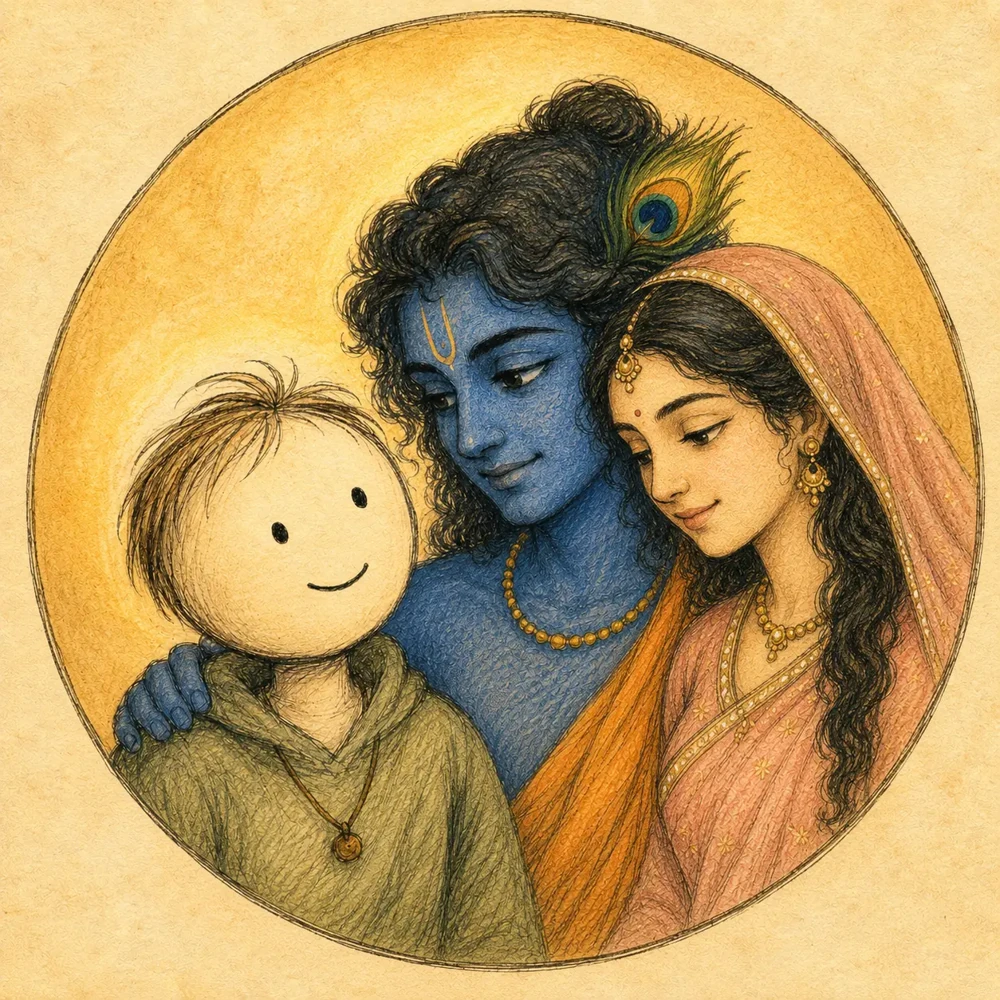

Shri Damodar Ashtakam Meaning in Hindi | सम्पूर्ण 8 श्लोकों का सरल अर्थ
- Published:
- Updated:
- Reviewed:
- 14 November 2026
Original verse
The original verse is shown in its source language.
Verse 1 — The Supreme Lord Dāmodara and Mother Yaśodā's Childhood Pastime
Original verse (Devanagari)
नमामीश्वरं सच्चिदानन्दरूपं लसत्कुण्डलं गोकुले भ्राजमानम् ।
यशोदाभियोलूखलाद्धावमानं परामृष्टमत्यन्ततो द्रुत्य गोप्या ॥१॥
Transliteration
namāmīśvaraṁ sac-cid-ānanda-rūpaṁ lasat-kuṇḍalaṁ gokule bhrājamānam।
yaśodā-bhiyolūkhalād dhāvamānaṁ parāmṛṣṭam atyantato drutya gopyā॥
Word-by-word meanings
namāmi — I bow; īśvaram — the Lord of all; sac-cid-ānanda-rūpam — the form eternally full of knowledge and bliss; lasat-kuṇḍalam — the shining earrings; gokule — in Gokula; bhrājamānam — shining; yaśodā-bhiyā — in fear of Yaśodā; ulūkhalāt — from the mortar; dhāvamānam — running away; parāmṛṣṭam — caught; atyantataḥ — exceedingly; drutyā — quickly; gopyā — by the gopī (Mother Yaśodā).
Translation
I bow to Lord Śrī Dāmodara, the Lord of all, whose form is eternally full of knowledge and bliss. Makara-shaped earrings shimmer beside His cheeks, and He shines in Gokula. In the childhood pastime of breaking the pot of curd, He runs away from the mortar in fear of Mother Yaśodā — and Mother Yaśodā runs even faster and catches Him from behind.
Explanation
Though He is the Lord of the universe, He runs in fear of His mother — that is the sweetness of His childhood pastime. A mother's love is so strong that she runs faster than Him and catches Him.
Summary
The Supreme Lord Kṛṣṇa is the baby cowherd boy, bound by Mother Yaśodā's love.
Verse 2 — The Tears of Baby Kṛṣṇa and His Mother's Loving Devotion
Original verse (Devanagari)
रुदन्तं मुहुर्नेत्रयुग्मं मृजन्तम् कराम्भोजयुग्मेन सातङ्कनेत्रम् ।
मुहुः श्वासकम्पत्रिरेखाङ्ककण्ठस्थितग्रैवं दामोदरं भक्तिबद्धम् ॥२॥
Transliteration
rudantaṁ muhur netra-yugmaṁ mṛjantam karāmbhoja-yugmena sātaṅka-netram।
muhuḥ śvāsa-kampa-trirekhāṅka-kaṇṭha-sthita-graivaṁ dāmodaraṁ bhakti-baddham॥
Word-by-word meanings
rudantam — weeping; muhuḥ — again and again; netra-yugmam — the two eyes; mṛjantam — rubbing; karāmbhoja-yugmena — with both lotus-like hands; sātaṅka-netram — with eyes anxious with fear; śvāsa-kampa — the trembling of sighs and breaths; trirekhāṅka-kaṇṭha-sthita-graivam — the pearl necklace resting on the three-lined throat; dāmodaram — Lord Dāmodara; bhakti-baddham — bound by loving devotion.
Translation
Seeing the stick in Mother Yaśodā's hand, baby Kṛṣṇa weeps again and again, rubbing His eyes with His two lotus-like hands. His eyes are anxious with fear. The pearl necklace resting on His three-lined throat trembles with His sobs and the shaking of His breath. I bow to Lord Śrī Dāmodara, bound by His mother's loving devotion.
Explanation
Baby Kṛṣṇa's weeping and rubbing His eyes is not fear but a pastime of love. The mother's stick is also love, and the child's fear is also a play of love.
Summary
I bow to Dāmodara, bound by His mother's loving devotion.
Verse 3 — Winning the Lord with Pure Love
Original verse (Devanagari)
इतीदृक्स्वलीलाभिरानन्दकुण्डे स्वघोषं निमज्जन्तमाख्यापयन्तम् ।
तदीयेषितज्ञेषु भक्तैर्जितत्वं पुनः प्रेमतस्तं शतावृत्ति वन्दे ॥३॥
Transliteration
itīdṛk sva-līlābhir ānanda-kuṇḍe svaghoṣaṁ nimajjantam ākhyāpayantam।
tadīyeṣita-jñeṣu bhaktair jitatvaṁ punaḥ prematas taṁ śatāvṛtti vande॥
Word-by-word meanings
itīdṛk — of this kind; sva-līlābhiḥ — by His own childhood pastimes; ānanda-kuṇḍe — in the lake of bliss; svaghoṣam — His own cowherd people; nimajjantam — immersing; ākhyāpayantam — declaring; tadīyeṣita-jñeṣu — among those who know His beloved devotees; bhaktaiḥ — by the devotees; jitatvam — being conquered; punaḥ — again; premataḥ — out of love; tam — unto Him; śatāvṛtti — a hundred times over; vande — I bow.
Translation
With such childhood pastimes, the Lord plunges the cowherd people of Gokula into a lake of bliss. He reveals even before those devotees who know His opulence and His true nature that devotees who hold intimate, pure love win Him over with their love. To that Śrī Dāmodara I bow lovingly, a hundred times over.
Explanation
The Lord shows even those who know His greatness that He is won not by opulence but by pure love. Love alone is the power that can bind the Lord of all.
Summary
With pure love, a devotee can win over even the Lord.
Verse 4 — May the Form of Bālagopāla Always Remain in My Mind
Original verse (Devanagari)
वरं देव मोक्षं न मोक्षावधिं वा न चान्यं वृणेऽहं वरेषादपीह ।
इदं ते वपुर्नाथ गोपालबालं सदा मे मनस्याविरास्तां किमन्यैः ॥४॥
Transliteration
varaṁ deva mokṣaṁ na mokṣāvadhiṁ vā na cānyaṁ vṛṇe'haṁ vareṣād apīha।
idaṁ te vapur nātha gopāla-bālaṁ sadā me manasy āvir āstāṁ kim anyaiḥ॥
Word-by-word meanings
varam — a boon; deva — O Lord; mokṣam — liberation; na — not; mokṣāvadhim — the highest limit of liberation; vā — or; na ca — nor; anyam — any other; vṛṇe — I ask for; aham — I; vareṣāt — from the giver of boons; api — even; iha — here; idam — this; te — Your; vapuḥ — form; nātha — O Lord; gopāla-bālam — the form of the cowherd boy; sadā — always; me — in my; manasi — mind; āvir āstām — may it be manifest; kim anyaiḥ — what need have I of others?
Translation
O Lord, You are the master of all boons. Yet I ask You neither for liberation, nor for attaining Vaikuṇṭha, nor for any other boon. O Lord, my only prayer is that this form of Yours as Bālagopāla may always remain manifest in my mind. What need have I of any other boon?
Explanation
The devotee sets aside even great boons like liberation and Vaikuṇṭha, asking only that the form of Bālagopāla remain always in the mind. One whose mind holds the Lord's form needs nothing else.
Summary
The greatest boon — that the form of Bālagopāla remain always in the mind.
Verse 5 — The Sweet Vision of the Lotus Face
Original verse (Devanagari)
इदं ते मुखाम्भोजमत्यन्तनीलैर्वृतं कुन्तलैः स्निग्धरक्तैश्च गोप्या ।
मुहुश्चुम्बितं बिम्बरक्ताधरं मे मनस्याविरास्तामलं लक्षलाभैः ॥५॥
Transliteration
idaṁ te mukhāmbhojam atyanta-nīlair vṛtaṁ kuntalaiḥ snigdha-raktaiś ca gopyā।
muhuś cumbitam bimba-raktādharaṁ me manasy āvir āstām alaṁ lakṣa-lābhaiḥ॥
Word-by-word meanings
idam — this; te — Your; mukhāmbhojam — lotus face; atyanta-nīlaiḥ — by the very dark; vṛtam — surrounded; kuntalaiḥ — by the curly locks; snigdha-raktaiḥ — smooth and reddish; ca — and; gopyā — by the gopī (Mother Yaśodā); muhuḥ — again and again; cumbitam — kissed; bimba-raktādharam — the lips red as a bimba fruit; me — in my; manasi — mind; āvir āstām — may it be manifest; alam — enough; lakṣa-lābhaiḥ — with millions of gains.
Translation
O Lord, Your lotus face is surrounded by deep dark hair, soft with a reddish glow, in curls. Mother Yaśodā kisses it again and again, and Your lips are red like the bimba fruit. May this sweet vision of Your lotus face always remain manifest in my mind. I have no desire for a hundred thousand other gains.
Explanation
The face that Mother Yaśodā kisses again and again is the devotee's greatest treasure. In exchange for this one vision, the devotee will not give it up for a hundred thousand gains.
Summary
The vision of Śrī Kṛṣṇa's lotus face is itself the greatest gain.
Verse 6 — A Prayer for the Merciful Glance and Darśana
Original verse (Devanagari)
नमो देव दामोदरानन्त विष्णो प्रसीद प्रभो दुःखजालाब्धिमग्नम् ।
कृपादृष्टिवृष्ट्यातिदीनं बतानु गृहाणेष मामज्ञमेध्यक्षिदृश्यः ॥६॥
Transliteration
namo deva dāmodarānanta viṣṇo prasīda prabho duḥkha-jālābdhi-magnam।
kṛpā-dṛṣṭi-vṛṣṭyāti-dīnaṁ batānu gṛhāṇeṣa mām ajñam edhy akṣi-dṛśyaḥ॥
Word-by-word meanings
namaḥ — obeisances; deva — O Lord; dāmodara — O Dāmodara; ananta — O endless One; viṣṇo — O Viṣṇu; prasīda — be pleased; prabho — O Master; duḥkha-jālābdhi-magnam — drowned in the ocean of the net of sorrows; kṛpā-dṛṣṭi-vṛṣṭyā — by the shower of Your merciful glance; atidīnam — the utterly helpless one; bata — alas; anu — with grace; gṛhāṇa — please accept; eṣa — this; mām — me; ajñam — ignorant; edhi — please become; akṣi-dṛśyaḥ — visible to the eyes.
Translation
O Lord, O Dāmodara, O Ananta, O Viṣṇu, I bow to You. O Lord, be pleased with me. Upon me — utterly helpless and ignorant, drowning in the great ocean of sorrows — shower the rain of Your merciful glance. O God, accept me with grace and appear before my eyes.
Explanation
The devotee does not hide his helplessness and ignorance; he places them before the Lord and asks for grace. Upon one who calls out, considering himself helpless, the Lord's merciful glance surely rains down.
Summary
Upon the call of the helpless devotee, the rain of the merciful glance falls.
Verse 7 — The Liberation of Nalakūvara and Maṇigrīva, and the Longing for Premabhakti
Original verse (Devanagari)
कुवेरात्मजौ बद्धमूर्त्यैव यद्वत् त्वया मोचितौ भक्तिभाजौ कृतौ च ।
तथा प्रेमभक्तिं स्वकां मे प्रयच्छ न मोक्षे ग्रहो मेऽस्ति दामोदरेह ॥७॥
Transliteration
kuverātmajau baddha-mūrtyaiva yadvat tvayā mocitau bhakti-bhājau kṛtau ca।
tathā prema-bhaktiṁ svakāṁ me prayaccha na mokṣe graho me'sti dāmodareha॥
Word-by-word meanings
kuverātmajau — the two sons of Kubera; baddha-mūrtyā — by Your bound form; eva — indeed; yadvat — just as; tvayā — by You; mocitau — they were liberated; bhakti-bhājau — made worthy of devotion; kṛtau — made; ca — and; tathā — in the same way; prema-bhaktim — loving devotion; svakām — Your own; me — to me; prayaccha — please grant; na — not; mokṣe — in liberation; grahaḥ — interest; me — my; asti — there is; dāmodara — O Dāmodara; iha — here.
Translation
O Dāmodara, just as, while bound to the mortar in Your childhood form, You freed Kubera's two sons, Nalakūvara and Maṇigrīva, from the curse of Nārada Muni and made them worthy of Your devotion, in the same way please grant me loving devotion to You. I have no longing to attain liberation. My desire is for loving devotion to You.
Explanation
The baby Kṛṣṇa bound to the mortar freed the cursed Nalakūvara and Maṇigrīva and gave them devotion — the same baby Kṛṣṇa can give the devotee premabhakti too. The devotee does not want liberation; he wants loving devotion, for in premabhakti itself lies closeness to the Lord.
Summary
Not liberation — premabhakti is the true desire.
Verse 8 — Obeisances to the Rope, the Belly, and Śrī Rādhikā
Original verse (Devanagari)
नमस्तेऽस्तु दाम्ने स्फुरद्दीप्तिधाम्ने त्वदीयोदरायाथ विश्वस्य धाम्ने ।
नमो राधिकायै त्वदीयप्रियायै नमोऽनन्तलीलाय देवाय तुभ्यम् ॥८॥
Transliteration
namas te'stu dāmne sphurad-dīpti-dhāmne tvadīyodarāyātha viśvasya dhāmne।
namo rādhikāyai tvadīya-priyāyai namo'nanta-līlāya devāya tubhyam॥
Word-by-word meanings
namaḥ — obeisances; te — unto You; astu — let there be; dāmne — unto the rope; sphurad-dīpti-dhāmne — unto the abode of shimmering radiance; tvadīyodarāya — unto Your belly; atha — and; viśvasya — of the whole universe; dhāmne — unto the shelter; namaḥ — obeisances; rādhikāyai — unto Śrī Rādhikā; tvadīya-priyāyai — unto Your beloved; namaḥ — obeisances; ananta-līlāya — unto the One of endless pastimes; devāya — unto the Lord; tubhyam — unto You.
Translation
O Lord, I bow to the radiant rope that binds Your belly. Then I bow to Your belly, the shelter of the entire universe. My respectful obeisances to Your beloved Śrī Rādhikā. Again and again I bow to You, the divine form who performs endless pastimes.
Explanation
The rope that bound the Lord of all is itself worthy of worship; the belly in which the whole world rests is itself worthy of worship; and to Śrī Rādhikā, His beloved, obeisances again and again.
Summary
To the rope, the belly and Śrī Rādhikā — obeisances; to the Lord of endless pastimes, obeisances again and again.
Greatness of the hymn
In Śrī Dāmodara Aṣṭakam, Śrī Kṛṣṇa, the Lord of the universe, appears as the baby cowherd boy, bound by Mother Yaśodā's love. In the Vaiṣṇava tradition, reciting it during the month of Kārtika and offering a lamp holds special importance. This hymn reminds us of His childhood pastimes and inspires us to hold the Lord's love as the most precious fruit of life.
How to recite
The month of Kārtika holds special importance for this recitation. Offer a lamp, sit before an image of Lord Bālagopāla, and recite with a calm mind.
Prayer
O Dāmodara, may Your form as Bālagopāla always remain manifest in my mind. Upon me, helpless and drowning in the ocean of sorrows, shower the rain of Your merciful glance, and grant me loving devotion to You.
Source: Śrī Dāmodarāṣṭakam (traditional text).
🙏 आपसे निवेदन
यदि यह पाठ आपके मन को छुआ हो तो कमेंट में प्रेम से लिखें — राधे राधे। इस वीडियो को अपने परिवार और प्रियजनों के साथ WhatsApp पर अवश्य शेयर करें, ताकि यह स्नेह भरा संदेश उन तक भी पहुँचे। ऐसे ही स्तोत्रों के सरल अर्थ सुनने के लिए राधा कृष्ण वाणी को सब्सक्राइब करें।
A humble request: If this hymn touched your heart, please write Radhe Radhe in the comments, share this video with your family and loved ones on WhatsApp, and subscribe to Radha Krishna Vani for more such simple meanings of sacred hymns.
Spotted an error? Please tell us in a YouTube comment. Watch on YouTube
Related videos
 9:52
Ashtakam
Yamunashtak Path Hindi Mein | Arth Sahit Sampurna | Yamunashtak Premanand Ji Maharaj | Nitya Niyam
 7:57
Ashtakam
Yamunashtakam Meaning in Hindi | यमुनाष्टक पाठ का सरल अर्थ | Adi Shankaracharya
 7:09
Ashtakam
Kaal Bhairav Ashtakam Hindi Meaning | कालभैरव अष्टकम सम्पूर्ण 8 श्लोक अर्थ सहित
 5:44
Ashtakam