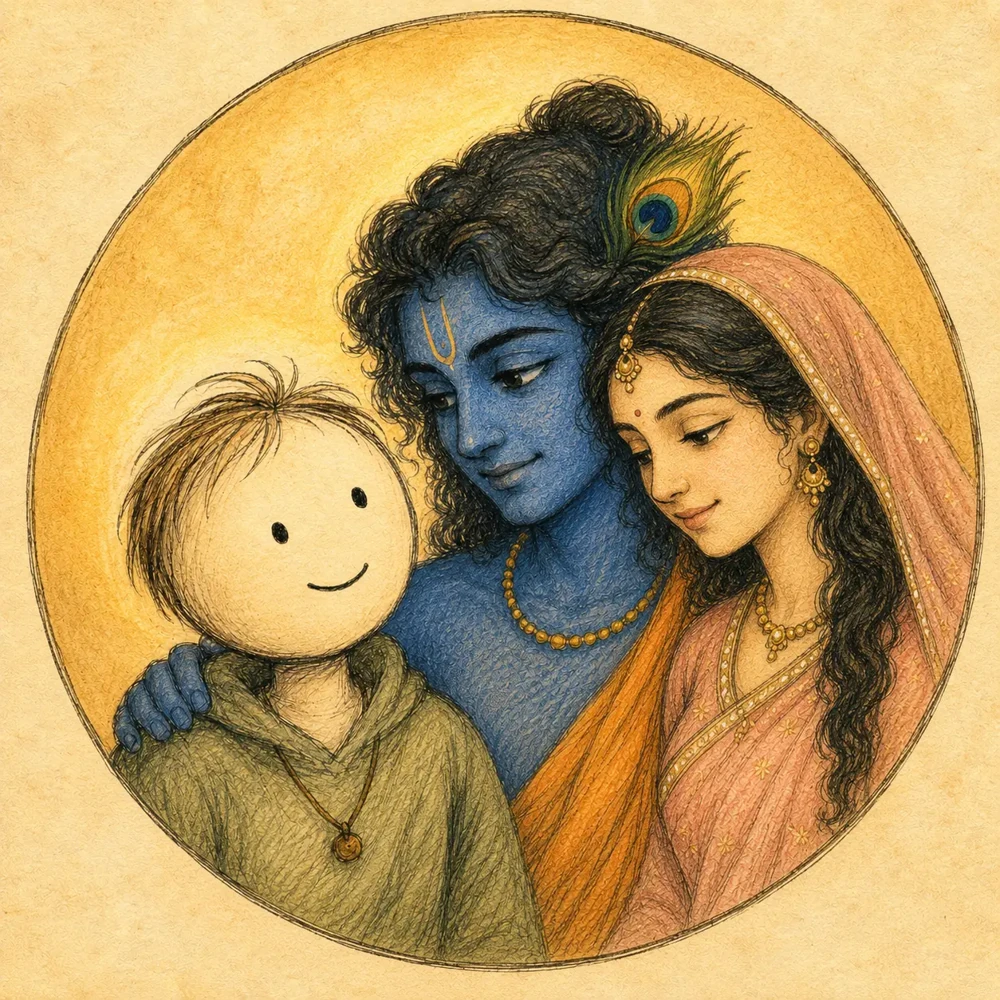

Gajendra Moksha Stotra Arth Sahit | Hindi Meaning, Bhavarth & Saar
- Published:
- Updated:
- Reviewed:
- 14 November 2026
Original verse
The original verse is shown in its source language.
Verse 1 — Fixing the Mind on the Lord
Original verse (Devanagari)
एवं व्यवसितो बुद्ध्या समाधाय मनोहृदि ।
जजाप परमं जाप्यं प्राग्जन्मन्यनुशिक्षितम् ॥ १॥
Transliteration
evaṁ vyavasito buddhyā samādhāya mano hṛdi |
jajāpa paramaṁ jāpyaṁ prāgjanmany anuśikṣitam ||
Word-by-word meanings
evaṁ — in this way; vyavasitaḥ — having decided; buddhyā — with the intellect; samādhāya — having steadied; manaḥ — the mind; hṛdi — within the heart; jajāpa — began to chant; paramaṁ jāpyam — the supreme prayer to be chanted; prāgjanmani — in a previous birth; anuśikṣitam — learned.
Translation
Śrī Śukadeva tells us that Gajendra, having decided with his intellect, steadied his mind within his heart and began to chant silently, in his mind, that supreme prayer which he had learned in a previous birth.
Explanation
In the hour of crisis, Gajendra did not run outward; he steadied his mind within and began to remember the Lord. The prayer was not new to him — it had been learned in a previous life and returned to him when he needed it most.
Summary
In a crisis, fixing the mind on the Lord can become the greatest support.
Verse 2 — The Lord, the Root of Consciousness
Original verse (Devanagari)
नमो भगवते तस्मै यत एतच्चिदात्मकम् ।
पुरुषायादिबीजाय परेशायाभिधीमहि ॥ २॥
Transliteration
namo bhagavate tasmai yata etac cidātmakam |
puruṣāyādibījāya pareśāyābhidhīmahi ||
Word-by-word meanings
namaḥ — obeisances; bhagavate — unto the Lord; tasmai — unto Him; yat — by whom; etat — this; cidātmakam — conscious in nature; puruṣāya — unto the Supreme Person; ādibījāya — the first cause of all; pareśāya — unto the Supreme Lord; abhidhīmahi — we meditate.
Translation
Gajendra bows to that Supreme Lord by whose consciousness even this inert body and mind become conscious and function. That Supreme Person is the first cause of all and the all-powerful God who dwells within everyone. Gajendra meditates on Him alone.
Explanation
The body and mind are not conscious by themselves — they become conscious through that supreme consciousness. The same Lord sits within every being and is able to do all things.
Summary
The Lord is the root of our consciousness and life force.
Verse 3 — The Support of All, Beyond All
Original verse (Devanagari)
यस्मिन्निदं यतश्चेदं येनेदं य इदं स्वयम् ।
योऽस्मात्परस्माच्च परस्तं प्रपद्ये स्वयम्भुवम् ॥ ३॥
Transliteration
yasminn idaṁ yataś cedaṁ yenedam ya idaṁ svayam |
yo 'smāt parasmāc ca paras taṁ prapadye svayambhuvam ||
Word-by-word meanings
yasmin — in whom; idam — this world; yataḥ — from whom; ca — and; yena — by whom; yaḥ — who; svayam — Himself; paraḥ — beyond; prapadye — I take shelter; svayambhuvam — of the self-born Lord.
Translation
This whole world rests on Him, has arisen from Him, is made by Him, and He Himself appears in its very form — yet the Lord remains beyond this visible world and its cause. Gajendra takes shelter of that self-born Lord.
Explanation
The Lord is within the world and also beyond it. The world is made by Him and rests in Him, yet He is bound by no limit.
Summary
The shelter of the One who is the support of all is the firmest refuge.
Verse 4 — Witness of the Manifest and the Unmanifest
Original verse (Devanagari)
यः स्वात्मनीदं निजमाययार्पितं
क्वचिद्विभातं क्व च तत्तिरोहितम् ।
अविद्धदृक् साक्ष्युभयं तदीक्षते
स आत्ममूलोऽवतु मां परात्परः ॥ ४॥
Transliteration
yaḥ svātmanīdaṁ nijamāyayārpitaṁ
kvacid vibhātaṁ kva ca tat tirohitam |
aviddhadṛk sākṣy ubhayaṁ tadīkṣate
sa ātmamūlo 'vatu māṁ parātparaḥ ||
Word-by-word meanings
yaḥ — who; svātmani — in His own Self; nijamāyayā — by His own power of māyā; arpitam — created; kvacit — sometimes; vibhātam — manifest; kva ca — and sometimes; tirohitam — unmanifest; aviddhadṛk — of unobstructed vision; sākṣī — the witness; ubhayam — of both; īkṣate — sees; ātmamūlaḥ — the root of all; avatu — may protect; mām — me; parātparaḥ — greater than the greatest.
Translation
By His own power of māyā, the Lord manifests this world within Himself, and at the time of dissolution the same world becomes unmanifest again. He is the witness of both states, manifest and unmanifest, and is untouched by them. Gajendra prays that the same supremely illuminating Lord may protect him.
Explanation
The world comes and goes, but the Lord remains as the witness of both states. He is not entangled in the world He manifests.
Summary
The world keeps changing. The Lord remains the witness and the supreme light.
Verse 5 — Light Beyond the Darkest Darkness
Original verse (Devanagari)
कालेन पञ्चत्वमितेषु कृत्स्नशो
लोकेषु पालेषु च सर्वहेतुषु ।
तमस्तदाऽऽसीद्गहनं गभीरं
यस्तस्य पारेऽभिविराजते विभुः ॥ ५॥
Transliteration
kālena pañcatvam iteṣu kṛtsnaśo
lokeṣu pāleṣu ca sarvahetuṣu |
tamas tadā āsīd gahanaṁ gabhīraṁ
yas tasya pāre 'bhivirājate vibhuḥ ||
Word-by-word meanings
kālena — by the influence of time; pañcatvam — dissolution into the five elements; iteṣu — when they have entered; kṛtsnaśaḥ — completely; lokeṣu — the worlds; pāleṣu — their protectors; sarvahetuṣu — all causes; tamaḥ — darkness; tadā — then; āsīt — remained; gahanam — deep; gabhīram — unfathomable; yaḥ — who; tasya — of that darkness; pāre — beyond; abhivirājate — shines forth; vibhuḥ — the all-pervading Lord.
Translation
When, under the influence of time, all the worlds, their protectors and even the cause of creation dissolve, a deep and unfathomable darkness remains. Beyond even that darkness shines the all-pervading Lord. Gajendra prays to Him for protection.
Explanation
Even in the darkness of dissolution, the Lord's light is not extinguished. Where everything dissolves, He still shines, all-pervading.
Summary
Beyond even the deepest darkness, the Lord's light shines.
Verse 6 — The Unfathomable Lord
Original verse (Devanagari)
न यस्यदेवा ऋषयःपदं विदु-
र्जन्तुः पुनः कोऽर्हति गन्तुमीरितुम् ।
यथा नटस्याकृतिभिर्विचेष्टतो
दुरत्ययानुक्रमणः स मावतु ॥ ६॥
Transliteration
na yasya devā ṛṣayaḥ padaṁ vidur
jantuḥ punaḥ ko 'rhati gantum īritum |
yathā naṭasyākṛtibhir viceṣṭato
duratyayānukramaṇaḥ sa mā vatu ||
Word-by-word meanings
na — not; yasya — whose; devāḥ — the gods; ṛṣayaḥ — the sages; padam — the true form; viduḥ — know; jantuḥ — an ordinary living being; punaḥ — then; kaḥ — who; arhati — is able; gantum — to know; īritum — to describe; yathā — just as; naṭasya — of an actor; ākṛtibhiḥ — by the many roles; viceṣṭataḥ — performing; duratyayānukramaṇaḥ — of unfathomable character; saḥ — He; mā — me; avatu — may protect.
Translation
Just as ordinary spectators cannot fully know the real form of an actor who takes on many roles, so even the gods and sages cannot fully know the real form of the Lord. Gajendra asks that unfathomable Lord for protection.
Explanation
Behind an actor's many costumes his true form stays hidden — likewise, behind the Lord's many forms, His real nature lies beyond the understanding of even gods and sages.
Summary
The Lord's glory is far greater than our intellect. His shelter alone is the refuge.
Verse 7 — The Goal and Refuge of the Sages
Original verse (Devanagari)
दिदृक्षवो यस्य पदं सुमङ्गलं
विमुक्त सङ्गा मुनयः सुसाधवः ।
चरन्त्यलोकव्रतमव्रणं वने
भूतात्मभूताः सुहृदः स मे गतिः ॥ ७॥
Transliteration
didṛkṣavo yasya padaṁ sumaṅgalaṁ
vimukta saṅgā munayaḥ susādhavaḥ |
caranty alokavratam avraṇaṁ vane
bhūtātmabhūtāḥ suhṛdaḥ sa me gatiḥ ||
Word-by-word meanings
didṛkṣavaḥ — desiring to see; yasya — whose; padam — the form; sumaṅgalam — supremely auspicious; vimukta-saṅgāḥ — free from attachment; munayaḥ — the sages; susādhavaḥ — of exceedingly saintly nature; caranti — practise; alokavratam — transcendental vows; avraṇam — unbroken; vane — in the forest; bhūtātmabhūtāḥ — regarding all beings as their own Self; suhṛdaḥ — well-wishers of all; saḥ — He; me — my; gatiḥ — goal and refuge.
Translation
The great sages, free from attachment, who regard all beings as their own and wish well for all, practise hard vows and disciplines with the desire to behold the supremely auspicious form of the Lord. Gajendra says, that same Lord is my goal and my refuge.
Explanation
Even the great sages practise discipline to behold the same Lord in whose shelter Gajendra has taken refuge. A mind free from attachment is a mind that moves towards the Lord.
Summary
Let attachment lessen, let goodwill for all awaken, and let the mind turn towards the Lord. That is the direction of spiritual practice.
Verse 8 — The Birth Free from Bondage
Original verse (Devanagari)
न विद्यते यस्य च जन्म कर्म वा
न नामरूपे गुणदोष एव वा ।
तथापि लोकाप्ययसम्भवाय यः
स्वमायया तान्यनुकालमृच्छति ॥ ८॥
Transliteration
na vidyate yasya ca janma karma vā
na nāmarūpe guṇadoṣa eva vā |
tathāpi lokāpyayasambhavāya yaḥ
svamāyayā tāny anukālam ṛcchati ||
Word-by-word meanings
na vidyate — there is not; yasya — whose; janma — birth; karma — karma-bound deeds; vā — or; nāmarūpe — name and form; guṇadoṣa — qualities and faults; tathāpi — yet; lokāpyayasambhavāya — for the creation and dissolution of the world; svamāyayā — by His own will; tāni — those (forms and births); anukālam — from time to time; ṛcchati — accepts.
Translation
The Lord's birth and deeds are not bound by karma as ours are. In His attributeless nature He is beyond name, form and the pairs of qualities and faults. Yet for the creation and dissolution of the world, He accepts form and birth from time to time, by His own will.
Explanation
The Lord takes birth, but He is not bound by karma. His coming is by His own will, for the welfare of the world.
Summary
The Lord appears in the world but is not bound by the world.
Verse 9 — Infinite Power, Infinite Forms
Original verse (Devanagari)
तस्मै नमः परेशाय ब्रह्मणेऽनन्तशक्तये ।
अरूपायोरुरूपाय नम आश्चर्यकर्मणे ॥ ९॥
Transliteration
tasmai namaḥ pareśāya brahmaṇe 'nantaśaktaye |
arūpāyorurūpāya nama āścaryakarmaṇe ||
Word-by-word meanings
tasmai — unto Him; namaḥ — obeisances; pareśāya — unto the Supreme Lord; brahmaṇe — unto the Supreme Brahman; anantaśaktaye — of infinite power; arūpāya — without material form; ururūpāya — of many forms; āścaryakarmaṇe — whose deeds are wonderful.
Translation
Gajendra bows to that Supreme Brahman of infinite power, who is not limited by any material form, yet appears in many forms and performs wonderful deeds.
Explanation
The Lord is not confined to a single form — His power is infinite and His forms are infinite too.
Summary
The Lord is not limited to any one form. His power and His forms are infinite.
Verse 10 — The Supreme Self Beyond Mind and Speech
Original verse (Devanagari)
नम आत्मप्रदीपाय साक्षिणे परमात्मने ।
नमो गिरां विदूराय मनसश्चेतसामपि ॥ १०॥
Transliteration
nama ātmapradīpāya sākṣiṇe paramātmane |
namo girāṁ vidūrāya manasaś cetasām api ||
Word-by-word meanings
namaḥ — obeisances; ātmapradīpāya — unto the self-luminous Self; sākṣiṇe — unto the witness of all; paramātmane — unto the Supreme Self; girām — of speech; vidūrāya — beyond the reach; manasaḥ — of the mind; cetasām — of the movements of the heart; api — even.
Translation
The Lord is the self-luminous Supreme Self and the witness of all. He is beyond the reach of the mind, speech and the movements of the heart. Gajendra bows again and again to such a Supreme Self.
Explanation
Where the thoughts of the mind and the words of speech come to an end, the Lord still is. He is self-luminous and the witness of everything.
Summary
Where mind and words reach their end, there too the Lord is.
Verse 11 — The Lord of Liberation
Original verse (Devanagari)
सत्त्वेन प्रतिलभ्याय नैष्कर्म्येण विपश्चिता ।
नमः कैवल्यनाथाय निर्वाणसुखसंविदे ॥ ११॥
Transliteration
sattvena pratilabhyāya naiṣkarmyeṇa vipaścitā |
namaḥ kaivalyanāthāya nirvāṇasukhasaṁvide ||
Word-by-word meanings
sattvena — by pure, sattvic conduct; pratilabhyāya — to be attained; naiṣkarmyeṇa — by desireless action; vipaścitā — by the discerning seeker; kaivalyanāthāya — unto the Lord of liberation; nirvāṇasukhasaṁvide — the very experience of the bliss of liberation.
Translation
The Lord whom discerning seekers attain through pure and desireless conduct is the Lord of liberation, the giver of the bliss of liberation, and the very experience of that supreme bliss. Gajendra bows to Him.
Explanation
Liberation is not a separate thing — the Lord Himself is both the Lord of liberation and the bliss of liberation. A pure, desireless life leads towards Him.
Summary
Pure and desireless practice leads the mind towards supreme peace and liberation.
Verse 12 — Equanimity Beyond Many Forms
Original verse (Devanagari)
नमः शान्ताय घोराय मूढाय गुणधर्मिणे ।
निर्विशेषाय साम्याय नमो ज्ञानघनाय च ॥ १२॥
Transliteration
namaḥ śāntāya ghorāya mūḍhāya guṇadharmiṇe |
nirviśeṣāya sāmyāya namo jñānaghanāya ca ||
Word-by-word meanings
śāntāya — unto the calm form; ghorāya — unto the fierce form; mūḍhāya — unto the dull form; guṇadharmiṇe — who assumes the qualities; nirviśeṣāya — free from all distinction; sāmyāya — established in equanimity; jñānaghanāya — full of knowledge; ca — and.
Translation
The Lord may appear in forms that seem calm through sattva, fierce through rajas, and dull through tamas. Yet in His true nature He is free from all distinction, established in equanimity, and full of knowledge. Gajendra bows to Him.
Explanation
Through the three qualities the Lord may appear in different forms, but His true nature is one — free from distinction, resting in equanimity, filled with knowledge.
Summary
Beyond many forms, the Lord is equanimity and the embodiment of knowledge.
Verse 13 — The Inner Witness of All
Original verse (Devanagari)
क्षेत्रज्ञाय नमस्तुभ्यं सर्वाध्यक्षाय साक्षिणे ।
पुरुषायात्ममूलाय मूलप्रकृतये नमः ॥ १३॥
Transliteration
kṣetrajñāya namas tubhyaṁ sarvādhyakṣāya sākṣiṇe |
puruṣāyātmamūlāya mūlaprakṛtaye namaḥ ||
Word-by-word meanings
kṣetrajñāya — unto the knower of all bodies; namas tubhyam — obeisances unto You; sarvādhyakṣāya — unto the master of all; sākṣiṇe — unto the witness; puruṣāya — unto the Supreme Person; ātmamūlāya — the root of the Self; mūlaprakṛtaye — the supreme cause of nature; namaḥ — obeisances.
Translation
The Lord is the true knower of every body and every sense, the master of all and the witness of all. He is the indweller of all, the supreme cause even of nature, and Himself the causeless Supreme Person. Gajendra bows to Him.
Explanation
The Lord knows from within, not from outside — He sits as the indweller in every body. He is the cause of all, yet He has no cause Himself.
Summary
The Lord is the witness within us. Nothing is hidden from Him.
Verse 14 — The Root Cause of All Experience
Original verse (Devanagari)
सर्वेन्द्रियगुणदृष्टे सर्व प्रत्यय हेतवे ।
असताच्छाययोक्ताय सदाभासाय ते नमः ॥ १४॥
Transliteration
sarvendriyaguṇadṛṣṭe sarva pratyaya hetave |
asatācchāyayoktāya sadābhāsāya te namaḥ ||
Word-by-word meanings
sarvendriyaguṇadṛṣṭe — unto the knower of all the senses and their objects; sarvapratyayahetave — the cause of all experiences; asatācchāyayoktāya — indicated by the shadow of the inert world; sadābhāsāya — the reflection of reality; te — unto You; namaḥ — obeisances.
Translation
The Lord is the knower of all the senses and their objects, and the root cause of all our experiences and perceptions. Even this inert world seems real only through the shadow and reflection of His being. Gajendra bows to Him.
Explanation
Behind everything we see, hear and experience stands that supreme reality. Whatever reality the inert world possesses comes to it as a shadow of His being.
Summary
This world too points towards the supreme reality that stands behind it.
Verse 15 — The Final Refuge of All Causes
Original verse (Devanagari)
नमो नमस्तेऽखिलकारणाय
निष्कारणायाद्भुतकारणाय ।
सर्वागमाम्नायमहार्णवाय
नमोऽपवर्गाय परायणाय ॥ १५॥
Transliteration
namo namas te 'khilakāraṇāya
niṣkāraṇāyādbhutakāraṇāya |
sarvāgamāmnāyamahārṇavāya
namo 'pavargāya parāyaṇāya ||
Word-by-word meanings
namo namaḥ — obeisances again and again; te — unto You; akhilakāraṇāya — the cause of all; niṣkāraṇāya — Yourself causeless; adbhutakāraṇāya — the wonderful cause; sarvāgamāmnāyamahārṇavāya — the great ocean of all the Vedas and scriptures; apavargāya — the embodiment of liberation; parāyaṇāya — the supreme refuge.
Translation
The Lord is the cause of all, yet He Himself has no cause. Though He is the cause, He undergoes no change. He is the supreme purport of all the Vedas and scriptures, the embodiment of liberation, and the final refuge of the best of seekers. Gajendra bows to Him again and again.
Explanation
Behind every cause there is another cause — but behind the Lord there is no cause. He is causeless, yet the cause of all.
Summary
The same Lord is the final refuge of all causes and all scriptures.
Verse 16 — Fire Hidden in Wood
Original verse (Devanagari)
गुणारणिच्छन्नचिदूष्मपाय
तत्क्षोभविस्फूर्जितमानसाय ।
नैष्कर्म्यभावेन विवर्जितागम-
स्वयंप्रकाशाय नमस्करोमि ॥ १६॥
Transliteration
guṇāraṇicchannacidūṣmapāya
tatkṣobhavisphūrjitamānasāya |
naiṣkarmyabhāvena vivarjitāgama-
svayaṁprakāśāya namaskaromi ||
Word-by-word meanings
guṇāraṇicchannacidūṣmapāya — unto the fire of knowledge hidden in the wood of the three qualities; tatkṣobhavisphūrjitamānasāya — whose mind stirs into the activity of creation when the qualities stir; naiṣkarmyabhāvena — by the spirit of desirelessness; vivarjitāgama — beyond the scriptural injunctions; svayamprakāśāya — self-luminous; namaskaromi — I offer obeisances.
Translation
Just as fire lies hidden in wood, so the Lord lies hidden within the three qualities like a fire of knowledge. When the qualities stir, the great activity of creation appears, and within the wise saints who rest in the essence of the Self, the same Lord shines forth by Himself.
Explanation
The Lord is not far away — He is hidden within the qualities themselves, like fire in wood. When the heart becomes pure, that light begins to be felt within.
Summary
When the heart becomes pure, the Lord's light hidden within begins to be felt.
Verse 17 — The Surrender of a Helpless Soul
Original verse (Devanagari)
मादृक्प्रपन्नपशुपाशविमोक्षणाय
मुक्ताय भूरिकरुणाय नमोऽलयाय ॥
स्वांशेन सर्वतनुभृन्मनसि प्रतीत
प्रत्यग्दृशे भगवते बृहते नमस्ते ॥ १७॥
Transliteration
mādṛk prapannapaśupāśavimokṣaṇāya
muktāya bhūrikaruṇāya namo 'layāya ||
svāṁśena sarvatanubhṛnmanasi pratīta
pratyagdṛśe bhagavate bṛhate namaste ||
Word-by-word meanings
mādṛk — like me; prapanna — surrendered; paśu — an animal-like soul; pāśavimokṣaṇāya — who cuts the bonds; muktāya — eternally liberated; bhūrikaruṇāya — supremely merciful; alayāya — never lazy in showing mercy; svāṁśena — by His partial feature; sarvatanubhṛt — of all embodied beings; manasi — in the mind; pratīta — manifest; pratyagdṛśe — the indwelling witness; bhagavate — unto the Lord; bṛhate — the unlimited; namas te — obeisances unto You.
Translation
Gajendra says, I am a helpless soul who has come to Your shelter. You cut the bonds of ignorance, You are supremely merciful, and You never delay in showing mercy. You also dwell within the hearts of all beings as the indweller. I bow to You.
Explanation
Gajendra does not hide his helplessness — that itself is his surrender. The Lord cuts bonds, never delays in mercy, and already dwells in every heart.
Summary
True surrender leads to the merciful Lord who cuts our bonds.
Verse 18 — Attachment and Non-Attachment
Original verse (Devanagari)
आत्माऽऽत्मजाप्तगृहवित्तजनेषु सक्तै-
र्दुष्प्रापणाय गुणसङ्गविवर्जिताय ।
मुक्तात्मभिः स्वहृदये परिभाविताय
ज्ञानात्मने भगवते नम ईश्वराय ॥ १८॥
Transliteration
ātmātmajāptagṛhavittajaneṣu saktair-
duṣprāpaṇāya guṇasaṅgavivarjitāya |
muktātmabhiḥ svahṛdaye paribhāvitāya
jñānātmane bhagavate nama īśvarāya ||
Word-by-word meanings
ātmā — the body; ātmaja — children; āpta — friends; gṛha — home; vitta — wealth; janeṣu — among one's own people; saktair — by those attached; duṣprāpaṇāya — hard to attain; guṇasaṅgavivarjitāya — free from attachment to the qualities; muktātmabhiḥ — by liberated souls; svahṛdaye — in their hearts; paribhāvitāya — constantly contemplated; jñānātmane — the embodiment of knowledge; bhagavate — unto the Lord; namaḥ — obeisances; īśvarāya — unto the almighty Lord.
Translation
For those who remain excessively attached to the body, children, friends, home, wealth and their own people, it becomes difficult to attain the Lord. Those who are free and unattached constantly contemplate in their hearts that Lord who is the embodiment of knowledge and all-powerful.
Explanation
Attachment binds the mind, so the Lord begins to feel distant. The unattached mind stays open and is able to contemplate the Lord.
Summary
Excessive attachment takes the mind away from the experience of the Lord.
Verse 19 — A Limited Ask, a Limitless Mercy
Original verse (Devanagari)
यं धर्मकामार्थविमुक्तिकामा
भजन्त इष्टां गतिमाप्नुवन्ति ।
किं त्वाशिषो रात्यपि देहमव्ययं
करोतु मेऽदभ्रदयो विमोक्षणम् ॥ १९॥
Transliteration
yaṁ dharmakāmārthavimuktikāmā
bhajanta iṣṭāṁ gatim āpnuvanti |
kiṁ tv āśiṣo rāty api deham avyayaṁ
karotu me 'dabhradayo vimokṣaṇam ||
Word-by-word meanings
yam — whom; dharmakāmārthavimuktikāmāḥ — those desiring dharma, pleasure, wealth or liberation; bhajantaḥ — worshipping; iṣṭām gatim — the desired destination; āpnuvanti — attain; kim tu — but; āśiṣaḥ — blessings; rāti — He gives; api — even; deham — a body; avyayam — imperishable; karotu — may He grant; me — to me; adabhradayaḥ — of boundless mercy; vimokṣaṇam — freedom (from this calamity).
Translation
Those who worship the Lord desiring dharma, wealth, pleasure or liberation attain the destination they desire, and the merciful Lord may also grant them other blessings without being asked. Gajendra prays that the same Lord may free him from this calamity forever.
Explanation
The Lord can give the seeker even more than what was asked — His mercy is greater than our asking.
Summary
Our asking may be limited, but the Lord's mercy is not limited.
Verse 20 — The Bliss of Desireless Devotion
Original verse (Devanagari)
एकान्तिनो यस्य न कञ्चनार्थं
वाञ्छन्ति ये वै भगवत्प्रपन्नाः ।
अत्यद्भुतं तच्चरितं सुमङ्गलं
गायन्त आनन्दसमुद्रमग्नाः ॥ २०॥
Transliteration
ekāntino yasya na kañcanārthaṁ
vāñchanti ye vai bhagavatprapannāḥ |
atyadbhutaṁ tac caritaṁ sumaṅgalaṁ
gāyanta ānandasamudramagnāḥ ||
Word-by-word meanings
ekāntinaḥ — the exclusive devotees; yasya — whose; na — not; kañcana — any; artham — object; vāñchanti — desire; ye — who; vai — indeed; bhagavatprapannāḥ — surrendered unto the Lord; atyadbhutam — most wonderful; tat — His; caritam — pastimes; sumaṅgalam — supremely auspicious; gāyantaḥ — singing; ānandasamudramagnāḥ — immersed in an ocean of bliss.
Translation
The Lord's exclusive devotees desire no object or reward from Him. They simply sing His supremely auspicious and wonderful pastimes and remain absorbed in an ocean of bliss.
Explanation
The true devotee wants nothing from the Lord — only the Lord Himself. Singing His pastimes is itself their bliss.
Summary
The sweetest form of devotion is to want nothing from the Lord, only the Lord.
Verse 21 — Beyond the Senses, Known Through Devotion
Original verse (Devanagari)
तमक्षरम्ब्रह्म परं परेश-
मव्यक्तमाध्यात्मिकयोगगम्यम् ।
अतीन्द्रियं सूक्ष्ममिवातिदूर-
मनन्तमाद्यं परिपूर्णमीडे ॥ २१॥
Transliteration
tam akṣaraṁ brahma paraṁ pareśam avyaktam ādhyātmikayogagamyam |
atīndriyaṁ sūkṣmam ivātidūram anantam ādyaṁ paripūrṇam īḍe ||
Word-by-word meanings
tam — unto Him; akṣaram — imperishable; brahma — Brahman; param — all-pervading; pareśam — the Supreme Lord; avyaktam — unmanifest; ādhyātmikayogagamyam — attainable through spiritual and devotional yoga; atīndriyam — beyond the senses; sūkṣmam — most subtle; iva — as if; atidūram — very far; anantam — infinite; ādyam — the first cause; paripūrṇam — complete; īḍe — I praise.
Translation
Gajendra praises that imperishable, all-pervading, supreme and complete Lord who cannot be reached by the ordinary senses, yet can be experienced through spirituality and the yoga of devotion. He is most subtle, infinite, and the first cause of all.
Explanation
The Lord cannot be seen by the eyes or touched by the hands, but He can be experienced through the path of devotion and spirituality.
Summary
The Lord is beyond the senses but can be experienced through practice and devotion.
Verse 22 — Creation, a Small Glimpse of His Power
Original verse (Devanagari)
यस्य ब्रह्मादयो देवा वेदा लोकाश्चराचराः ।
नामरूपविभेदेन फल्ग्व्या च कलया कृताः ॥ २२॥
Transliteration
yasya brahmādayo devā vedā lokāś carācarāḥ |
nāmarūpavibhedena phalgvyā ca kalayā kṛtāḥ ||
Word-by-word meanings
yasya — from whom; brahmādayaḥ — Brahmā and the others; devāḥ — the gods; vedāḥ — the Vedas; lokāḥ — the worlds; carācarāḥ — moving and unmoving; nāmarūpavibhedena — with differences of name and form; phalgvyā — by a very small; kalayā — portion of power; kṛtāḥ — created.
Translation
From Lord Brahmā to the other gods, the four Vedas, and this entire world of moving and unmoving beings — all have appeared, with their different names and forms, from a very small portion of the Lord's power.
Explanation
Brahmā, the gods, the Vedas and this vast world are all only a small portion of the Lord's power.
Summary
Even so vast a creation is only a small glimpse of the Lord's power.
Verse 23 — Arisen from the Source, Returning to the Source
Original verse (Devanagari)
यथार्चिषोऽग्नेः सवितुर्गभस्तयो
निर्यान्ति संयान्त्यसकृत्स्वरोचिषः ।
तथा यतोऽयं गुणसम्प्रवाहो
बुद्धिर्मनः खानि शरीरसर्गाः ॥ २३॥
Transliteration
yathārciṣo 'gneḥ savitur gabhastayo
niryānti saṁyānty asakṛt svarociṣaḥ |
tathā yato 'yaṁ guṇasampravāho
buddhir manaḥ khāni śarīrasargāḥ ||
Word-by-word meanings
yathā — just as; arciṣaḥ — flames; agneḥ — from fire; savituḥ — from the sun; gabhastayaḥ — rays; niryānti — come out; saṁyānti — return; asakṛt — again and again; svarociṣaḥ — into their own light; tathā — so too; yataḥ — from whom; ayam — this; guṇasampravāhaḥ — the flow of the qualities; buddhiḥ — intellect; manaḥ — mind; khāni — the senses; śarīrasargāḥ — the hosts of bodies.
Translation
Just as flames arise from fire and rays from the sun and then return to their source, so the intellect, the mind, the senses and the many kinds of bodies arise from the Lord and in the end merge back into Him.
Explanation
Flames come from fire and return to fire — likewise, everything comes from the Lord and returns to the Lord.
Summary
All arise from that supreme source and in the end return to it.
Verse 24 — Beyond Every Limited Identity
Original verse (Devanagari)
स वै न देवासुरमर्त्यतिर्यङ्
न स्त्री न षण्डो न पुमान्न जन्तुः ।
नायं गुणः कर्म न सन्न चासन्
निषेधशेषो जयतादशेषः ॥ २४॥
Transliteration
sa vai na devāsuramartyatiryaṅ
na strī na ṣaṇḍo na pumān na jantuḥ |
nāyaṁ guṇaḥ karma na san na cāsan
niṣedhaśeṣo jayatād aśeṣaḥ ||
Word-by-word meanings
saḥ — He; vai — indeed; na — not; deva — a god; asura — a demon; martya — a man; tiryak — an animal; strī — a woman; ṣaṇḍaḥ — a neuter; pumān — a man; jantuḥ — a living being; ayam — this; guṇaḥ — a quality; karma — an action; sat — an effect; asat — a cause; niṣedhaśeṣaḥ — what remains after all negation; jayatāt — may He be glorified; aśeṣaḥ — the unlimited whole.
Translation
The Lord cannot be confined to any one limited identity. He is neither a god, nor a demon, nor a man, nor an animal, neither a woman nor a man, nor any living being limited to a material category. He is not merely any quality, action, deed or cause either. When all these limited identities are denied, the supreme truth that remains is His nature.
Explanation
The Lord cannot be fitted into any name, form or category. Whatever is limited is not His nature — what remains after setting all of it aside is the supreme truth that He is.
Summary
The Lord is the supreme truth beyond every limited identity of ours.
Verse 25 — Freedom from the Ignorance Within
Original verse (Devanagari)
जिजीविषे नाहमिहामुया कि-
मन्तर्बहिश्चावृतयेभयोन्या ।
इच्छामि कालेन न यस्य विप्लव-
स्तस्यात्मलोकावरणस्य मोक्षम् ॥ २५॥
Transliteration
jijīviṣe nāham ihāmuyā kim antarbahiś cāvṛtayebhayonyā |
icchāmi kālena na yasya viplavas tasyātmalokāvaraṇasya mokṣam ||
Word-by-word meanings
jijīviṣe — to live on; na — not; aham — I; iha — here; amuyā — by this (elephant body); kim — what use; antarbahiḥ — inside and outside; āvṛtaye — covered; abhayonyā — by ignorance; icchāmi — I desire; kālena — by the passing of time; na — not; yasya — whose; viplavaḥ — destruction; tasya — of that; ātmalokāvaraṇasya — the veil over the light of the Self; mokṣam — freedom.
Translation
Gajendra says, I do not merely wish to escape the crocodile and keep this elephant body alive. My true wish is to be freed from the veil of ignorance that has covered the light of the Self. This ignorance is not removed merely by the passing of time. It is destroyed by the Lord's grace and the dawning of knowledge.
Explanation
Gajendra's prayer is not limited to saving his body — he seeks freedom from the ignorance within. The passing of time does not remove ignorance; the Lord's grace and knowledge do.
Summary
Greater than freedom from an outer crisis is freedom from the ignorance within.
Verse 26 — The Soul of the Universe, the Supreme Refuge
Original verse (Devanagari)
सोऽहं विश्वसृजं विश्वमविश्वं विश्ववेदसम् ।
विश्वात्मानमजं ब्रह्म प्रणतोऽस्मि परं पदम् ॥ २६॥
Transliteration
so 'haṁ viśvasṛjaṁ viśvam aviśvaṁ viśvavedasam |
viśvātmānam ajaṁ brahma praṇato 'smi paraṁ padam ||
Word-by-word meanings
saḥ — He; aham — I; viśvasṛjam — the creator of the universe; viśvam — the universe itself; aviśvam — beyond the universe; viśvavedasam — the knower of the universe; viśvātmānam — the Soul of the universe; ajam — the unborn; brahma — the Supreme Brahman; praṇataḥ asmi — I bow down; param padam — the supreme goal.
Translation
Gajendra bows to the Lord who is the creator of the world, who appears as the world itself yet remains beyond it, the knower and support of the universe, the Soul of the universe, the unborn and the Supreme Brahman. He regards Him alone as the supreme goal and his final refuge.
Explanation
The Lord is the creator of the world and also beyond it. He is the Soul of the universe — the knower of all, the support of all, and the unborn Supreme Brahman.
Summary
The spirit of true surrender is this — O Lord, You alone are my supreme refuge.
Verse 27 — Devotion Purifies the Heart and Leads to Realisation
Original verse (Devanagari)
योगरन्धितकर्माणो हृदि योगविभाविते ।
योगिनो यं प्रपश्यन्ति योगेशं तं नतोऽस्म्यहम् ॥ २७॥
Transliteration
yogarandhitakarmāṇo hṛdi yogavibhāvite |
yogino yaṁ prapaśyanti yogeśaṁ taṁ nato 'smy aham ||
Word-by-word meanings
yogarandhitakarmāṇaḥ — those who have burnt their karma through yoga; hṛdi — in the heart; yogavibhāvite — purified by yoga; yoginaḥ — the yogīs; yam — whom; prapaśyanti — behold; yogeśam — the Master of yoga; tam — unto Him; nataḥ asmi — I bow; aham — I.
Translation
Those yogīs who, through the yoga of devotion, have burnt away the bonds of their karma behold the Lord, the Master of yoga, in their hearts purified by yoga. Gajendra bows to that Lord.
Explanation
The yoga of devotion burns away the bonds of karma and purifies the heart. It is in the purified heart that the Master of yoga is realised.
Summary
Devotion too purifies the heart and leads towards the realisation of the Lord.
Verse 28 — The Force of the Three Powers
Original verse (Devanagari)
नमो नमस्तुभ्यमसह्य वेग-
शक्तित्रयायाखिलधीगुणाय ।
प्रपन्नपालाय दुरन्तशक्तये
कदिन्द्रियाणामनवाप्यवर्त्मने ॥ २८॥
Transliteration
namo namas tubhyam asahyavega-śaktitrayāyākhiladhīguṇāya |
prapannapālāya durantaśaktaye
kad indriyāṇām anavāpyavartmane ||
Word-by-word meanings
namo namaḥ — obeisances again and again; tubhyam — unto You; asahyavegaśaktitrayāya — of three powers of unbearable force; akhiladhīguṇāya — appearing as all the objects of the senses; prapannapālāya — the protector of the surrendered; durantaśaktaye — of immeasurable power; kadā — ever; indriyāṇām — of the senses; anavāpyavartmane — whose path cannot be found.
Translation
The force of the Lord's three kinds of powers is extremely strong. He also appears in the form of all the objects of the senses. He is the protector of surrendered souls, and His power is immeasurable. But for those whose senses remain entangled in sense objects alone, it becomes very difficult to find the Lord's path.
Explanation
The Lord's power is immeasurable and He protects the one who surrenders to Him. But for one who remains entangled in sense objects, the path stays covered.
Summary
Entanglement in the senses covers the path. The Lord Himself is the protector of the surrendered soul.
Verse 29 — Ego and Surrender
Original verse (Devanagari)
नायं वेद स्वमात्मानं यच्छक्त्याहन्धिया हतम् ।
तं दुरत्ययमाहात्म्यं भगवन्तमितोऽस्म्यहम् ॥ २९॥
Transliteration
nāyaṁ veda svam ātmānaṁ yac chaktyāhaṁdhiyā hatam |
taṁ duratyayamāhātmyaṁ bhagavantam ito 'smy aham ||
Word-by-word meanings
na — not; ayam — this soul; veda — knows; svam — his own; ātmānam — true Self; yat — whose; śaktyā — by the power; ahaṁdhiyā — of ego; hatam — covered; tam — unto Him; duratyayamāhātmyam — of immeasurable and unfathomable glory; bhagavantam — the Lord; itaḥ asmi — I have come (for shelter); aham — I.
Translation
Because of the ego born of the Lord's power of nescience, the soul cannot recognise its true Self. Gajendra takes shelter of that Lord of immeasurable and unfathomable glory.
Explanation
Ego covers the soul's true identity. The way to see the covered truth again is the Lord's shelter.
Summary
Ego covers our true identity. The Lord's shelter brings us back towards truth.
Verse 30 — A Cry That Reached the Supreme Refuge
Original verse (Devanagari)
एवं गजेन्द्रमुपवर्णितनिर्विशेषं
ब्रह्मादयो विविधलिङ्गभिदाभिमानाः ।
नैते यदोपससृपुर्निखिलात्मकत्वात्
तत्राखिलामरमयो हरिराविरासीत् ॥ ३०॥
Transliteration
evaṁ gajendram upavarṇitanirviśeṣaṁ
brahmādayo vividhaliṅgabhidābhimānāḥ |
naite yadopasasṛpur nikhilātmakatvāt
tatrākhilāmaramayo harir āvirāsīt ||
Word-by-word meanings
evam — in this way; gajendram — of Gajendra; upavarṇitanirviśeṣam — who had described the distinctionless (Lord); brahmādayaḥ — Brahmā and the other gods; vividhaliṅgabhidābhimānāḥ — proud of their distinct forms; na — not; ete — they; yadā — when; upasasṛpuḥ — approached; nikhilātmakatvāt — because He is the Self of all; tatra — there; akhilāmaramayaḥ — the embodiment of all the gods; hariḥ — Śrī Hari; āvirāsīt — appeared.
Translation
Śrī Śukadeva tells us that Gajendra had praised that supreme form of the Lord which is not bound to any one limited divine form. Therefore the gods, beginning with Brahmā, proud of their own distinct forms, did not come forward, and Śrī Hari Himself, the embodiment of all the gods, appeared there.
Explanation
Gajendra's cry was not addressed to any one god — it reached the Supreme Lord who is the form of all the gods. That is why Śrī Hari Himself came.
Summary
Gajendra's cry did not stop at any limited support. It reached the supreme refuge.
Verse 31 — Śrī Hari Arrives on Garuḍa
Original verse (Devanagari)
तं तद्वदार्त्तमुपलभ्य जगन्निवासः
स्तोत्रं निशम्य दिविजैः सह संस्तुवभिः ।
छन्दोमयेन गरुडेन समुह्यमान-
श्चक्रायुधोऽभ्यगमदाशु यतो गजेन्द्रः ॥ ३१॥
Transliteration
taṁ tadvadārttam upalabhya jagannivāsaḥ
stotraṁ niśamya divijaiḥ saha saṁstuvadbhiḥ |
chandomayena garuḍena samuhyamānaś
cakrāyudho 'bhyagamad āśu yato gajendraḥ ||
Word-by-word meanings
tam — him (Gajendra); tadvat — in that condition; ārttam — distressed; upalabhya — seeing; jagannivāsaḥ — the abode of the universe, the Lord; stotram — the prayer; niśamya — hearing; divijaiḥ — with the gods; saha — together; saṁstuvadbhiḥ — offering praises; chandomayena — Vedic; garuḍena — on Garuḍa; samuhyamānaḥ — riding; cakrāyudhaḥ — bearing the discus as His weapon; abhyagamat — arrived; āśu — swiftly; yataḥ — where; gajendraḥ — Gajendra was.
Translation
The Lord saw Gajendra's suffering and heard his prayer. Taking the Sudarśana discus and His other weapons, He mounted Garuḍa and arrived there with great speed. The gods too came along with Him, singing His praises.
Explanation
The Lord did not only hear Gajendra's prayer — He also saw his suffering. That is why He came without delay, riding Garuḍa, bearing His weapons.
Summary
The Lord does not only hear prayer. He also sees the devotee's suffering.
Verse 32 — A Lotus in the Trunk, a True Salutation
Original verse (Devanagari)
सोऽन्तस्सरस्युरुबलेन गृहीत आर्त्तो
दृष्ट्वा गरुत्मति हरिं ख उपात्तचक्रम् ।
उत्क्षिप्य साम्बुजकरं गिरमाह कृच्छ्रा-
न्नारायणाखिलगुरो भगवन् नमस्ते ॥ ३२॥
Transliteration
so 'ntassarasy urubalena gṛhīta ārtto
dṛṣṭvā garutmati hariṁ kha upāttacakram |
utkṣipya sāmbujakaraṁ giram āha kṛcchrān
nārāyaṇākhilaguro bhagavan namaste ||
Word-by-word meanings
saḥ — he (Gajendra); antaḥsarasi — within the lake; urubalena — by the mighty (crocodile); gṛhītaḥ — seized; ārttaḥ — distressed; dṛṣṭvā — seeing; garutmati — on Garuḍa; harim — Lord Hari; khe — in the sky; upāttacakram — holding the discus; utkṣipya — lifting up; sāmbujakaram — his trunk with a lotus; giram — words; āha — spoke; kṛcchrāt — with great difficulty; nārāyaṇa — O Nārāyaṇa; akhilaguro — O teacher of all; bhagavan — O Lord; namas te — obeisances unto You.
Translation
Tormented greatly by the crocodile's powerful grip, Gajendra saw in the sky Lord Śrī Hari, riding Garuḍa and holding the discus in His hand. With great difficulty he lifted a lotus in his trunk and said — O Nārāyaṇa, O teacher of all, O Lord, salutations to You.
Explanation
Gajendra had no strength left, but love remained. A lotus lifted with great difficulty and one true salutation — that was his offering.
Summary
Even when strength fails, one true salutation offered with love is of great value.
Verse 33 — Freedom from the Crocodile
Original verse (Devanagari)
तं वीक्ष्य पीडितमजः सहसावतीर्य
सग्राहमाशु सरसः कृपयोज्जहार ।
ग्राहाद्विपाटितमुखादरिणा गजेन्द्रं
सम्पश्यतां हरिरमूमुचदुस्त्रियाणाम् ॥ ३३॥
Transliteration
taṁ vīkṣya pīḍitam ajaḥ sahasāvatīrya
sagrāham āśu sarasaḥ kṛpayojjahāra |
grāhād vipāṭitamukhād ariṇā gajendraṁ
saṁpaśyatāṁ harir amūmucad ustriyāṇām ||
Word-by-word meanings
tam — him (Gajendra); vīkṣya — seeing; pīḍitam — in pain; ajaḥ — the unborn Lord; sahasā — at once; avatīrya — descending; sagrāham — together with the crocodile; āśu — swiftly; sarasaḥ — from the lake; kṛpayā — out of compassion; ujjahāra — lifted out; grāhāt — from the crocodile; vipāṭitamukhāt — whose mouth was torn open; ariṇā — with the discus; gajendram — Gajendra; sampasyatām — while (the gods) looked on; hariḥ — Śrī Hari; amūmucat — freed (him); ustriyāṇām — in their presence.
Translation
Seeing Gajendra in pain, the unborn Śrī Hari at once descended from Garuḍa. Moved by compassion, He lifted Gajendra, along with the crocodile, out of the water, and tore open the crocodile's mouth with the Sudarśana discus, freeing Gajendra from its grip.
Explanation
Where Gajendra's own strength had ended, there the Lord's grace lifted him. Śrī Hari Himself descended and cut the crocodile's grip with His discus.
Summary
Where our own strength ends, there the Lord's grace can lift us.
Greatness of the hymn
The story of Gajendra's liberation appears in the Eighth Canto of the Śrīmad Bhāgavatam. While bathing in a lake, the king of elephants, Gajendra, had his leg seized by a crocodile. After a long struggle, when his own strength was spent, Gajendra remembered the prayer he had learned in a previous birth and took shelter of the Supreme Lord. Hearing his cry, Śrī Hari came Himself, riding Garuḍa, and cut the crocodile's grip with the Sudarśana discus, freeing Gajendra.
The greatness of this hymn lies in its surrender. Gajendra asked for more than the safety of his body — he asked for freedom from the ignorance within. The one who, in a crisis, trusts not his own strength but the Lord's grace finds his cry reaching the supreme refuge.
The essence of the whole hymn
Where our own strength ends, there the Lord's grace can lift us.
How to recite
Sit calmly, in the morning or evening, before a picture or form of Śrī Hari and remember this hymn slowly, keeping the meaning of each verse in mind. Read each verse with understanding, and afterwards sit in silence for a few moments and remember Śrī Hari. Even in times of difficulty, remembering the meaning of this hymn steadies the mind.
Prayer
O Śrī Hari, O Nārāyaṇa, O teacher of all, salutations to You. Just as You heard Gajendra's cry and freed him from the crocodile's grip, remove the veil of ignorance within us. Cut away our attachment and ego, and keep us in Your shelter.
Source: Śrīmad Bhāgavatam, Eighth Canto, the Gajendra-Mokṣa episode.
Radhe Radhe 🙏
If this simple meaning brought you even a little closer to Śrī Hari, please write with love in the comments — Radhe Radhe. Share this video with your family and friends on WhatsApp, so they too can understand the meaning of the Gajendra Moksha Stotra with ease. On Radha Krishna Vani we share the meanings of such sacred scriptures in simple language. To stay connected, subscribe to the channel and press the bell. Which hymn would you like to understand next? Do tell us in the comments. Radhe Radhe.
Spotted an error? Please tell us in a YouTube comment. Watch on YouTube
Related videos
 17:24
Stotra
Radha Kripa Kataksh Stotram | Sampurna Path Hindi Mein | Mahadev Ne Likhi Radha Ji Ki Stuti
 12:51
Stotra
Shri Suktam Meaning in Hindi | श्रीसूक्त का सम्पूर्ण सरल हिन्दी अर्थ, भावार्थ और सार
 24:30
Stotra
Shri Hanuman Bahuk in Hindi | हनुमान बाहुक अर्थ सहित | सम्पूर्ण 44 छंद
 10:50
Stotra