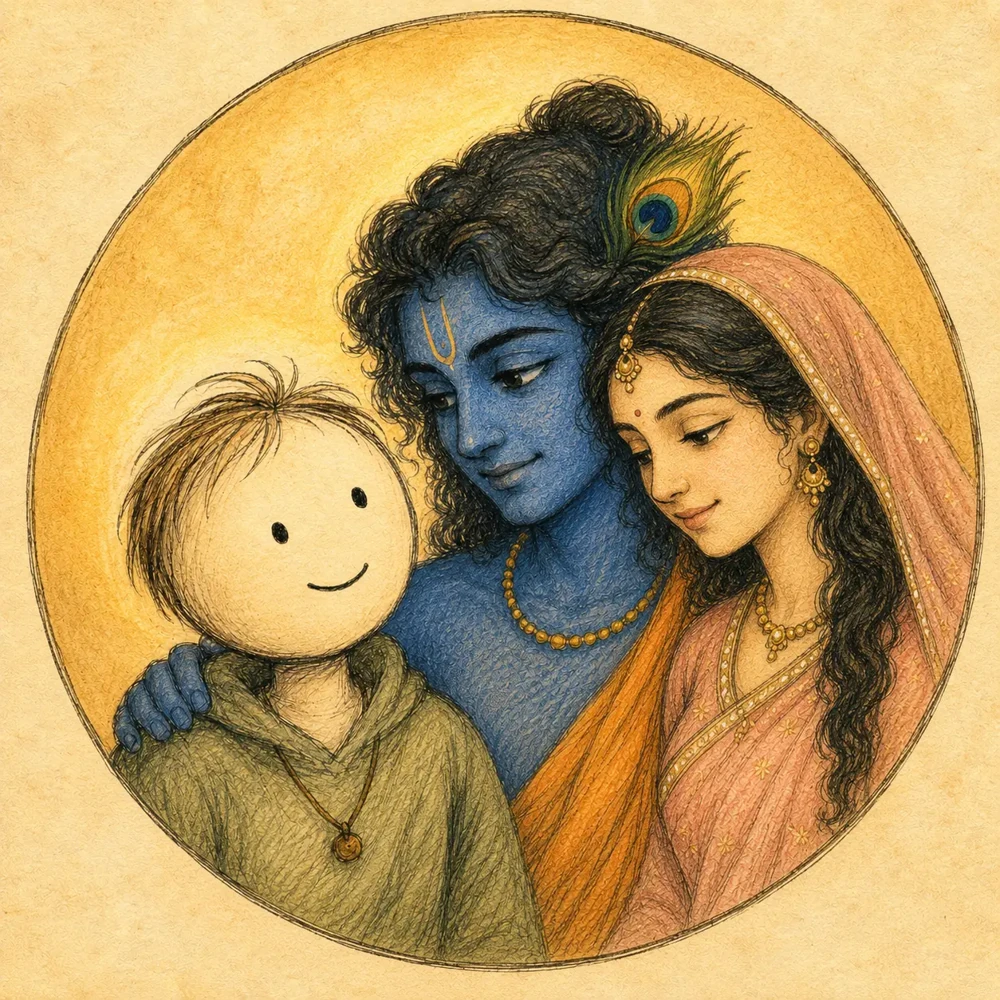

Kanakadhara Stotram in Hindi | कनकधारा स्तोत्र हिंदी में | संपूर्ण पाठ सरल हिंदी अर्थ सहित
- Published:
- Updated:
- Reviewed:
- 14 November 2026
Original verse
The original verse is shown in its source language.
Verse 1 — The Auspicious Glance of Love
Original verse (Devanagari)
अङ्गं हरेः पुलकभूषणमाश्रयन्ती भृङ्गाङ्गनेव मुकुलाभरणं तमालम्।
अङ्गीकृताखिलविभूतिरपाङ्गलीला माङ्गल्यदास्तु मम मङ्गलदेवतायाः॥१॥
Transliteration
aṅgaṁ hareḥ pulaka-bhūṣaṇam-āśrayantī bhṛṅgāṅganeva mukulābharaṇaṁ tamālam। aṅgīkṛtākhila-vibhūtir-apāṅga-līlā māṅgalya-dāstu mama maṅgala-devatāyāḥ॥
Word-by-word meanings
aṅgam — the body (of Hari); hareḥ — of Hari; pulaka-bhūṣaṇam — adorned with horripilation; āśrayantī — resting upon; bhṛṅgāṅganā iva — like a female bee; mukula-ābharaṇam tamālam — the tamāla tree adorned with buds; aṅgīkṛta-akhila-vibhūtiḥ — who has embraced all opulence; apāṅga-līlā — the play of the sidelong glance; māṅgalya-dā — giver of auspiciousness; astu — may it be; mama — for me; maṅgala-devatāyāḥ — of the goddess of auspiciousness.
Translation
May the loving sidelong glance of the goddess of auspiciousness — who rests upon the body of Hari, thrilled with joy like a female bee settling upon a tamāla tree adorned with buds, and who has embraced all opulence — bring auspiciousness into my life as well.
Explanation
The hymn opens with a tender image: Mother Lakṣmī's glance rests upon Lord Hari's body as lovingly as a female bee rests upon a bud-laden tamāla tree. She who holds all opulence within Herself is the goddess of auspiciousness, and the poet prays that her loving glance may bring goodness into his life too.
Summary
Mother Lakṣmī's loving glance brings auspiciousness into life.
Verse 2 — The Garland of Bashful Glances
Original verse (Devanagari)
मुग्धा मुहुर्विदधती वदने मुरारेः प्रेमत्रपाप्रणिहितानि गतागतानि।
माला दृशोर्मधुकरीव महोत्पले या सा मे श्रियं दिशतु सागरसम्भवायाः॥२॥
Transliteration
mugdhā muhur-vidadhatī vadane murāreḥ prema-trapā-praṇihitāni gatāgatāni। mālā dṛśor-madhukarīva mahotpale yā sā me śriyaṁ diśatu sāgara-sambhavāyāḥ॥
Word-by-word meanings
mugdhā — enchanted; muhuḥ — again and again; vidadhatī — making; vadane — towards the face; murāreḥ — of Murāri (Śrī Hari); prema — with love; trapā — with shyness; praṇihitāni — returning; gatāgatāni — goings and comings; mālā — the garland; dṛśoḥ — of the glances; madhukarī — the female bee; iva — like; mahotpale — at the great lotus; yā — which; sā — that; me — to me; śriyam — happiness and prosperity; diśatu — may it give; sāgarasambhavāyāḥ — of the ocean-born (Mother Lakṣmī).
Translation
Mother Lakṣmī's eyes go again and again with love towards the face of Śrī Hari, and return out of shyness — just as a female bee hovers around a great lotus. May that garland of delightful glances of Mother Lakṣmī, who arose from the ocean, give me too happiness and prosperity.
Explanation
The Mother's glance is full of love and shyness — it goes towards Hari's face again and again and returns. That same delightful glance, like a garland, brings the devotee happiness and prosperity.
Summary
The Mother's loving glance gives the devotee happiness and prosperity.
Verse 3 — The Glance That Can Grant Indra's Throne
Original verse (Devanagari)
विश्वामरेन्द्रपदविभ्रमदानदक्षमानन्दहेतुरधिकं मुरविद्विषोऽपि।
ईषन्निषीदतु मयि क्षणमीक्षणार्धमिन्दीवरोदरसहोदरमिन्दिरायाः॥३॥
Transliteration
viśva-amara-indra-pada-vibhrama-dāna-dakṣam ānanda-hetur-adhikam mura-vidviṣo'pi। īṣan-niṣīdatu mayi kṣaṇam-īkṣaṇārdham indīvara-udara-sahodaram-indirāyāḥ॥
Word-by-word meanings
viśvāmareṇdra — Indra, the king of the gods; pada — the throne; vibhrama — the splendour; dāna — in granting; dakṣam — able; ānanda-hetuḥ — the cause of joy; adhikam — great; mura-vidviṣaḥ — to the foe of Mura (Śrī Hari); api — even; īṣat — for a moment; niṣīdatu — may it rest; mayi — upon me; kṣaṇam — for an instant; īkṣaṇārdham — the half-glance; indīvara — the blue lotus; udara — the inside; sahodaram — the sibling; indirāyāḥ — of Indirā (Mother Lakṣmī).
Translation
Mother Lakṣmī's glance is capable of granting the throne of Indra, the king of the gods, and all its splendour, and it gives great joy even to Lord Viṣṇu. May that glance of Hers, beautiful like the inner part of a blue lotus, rest upon me too for a moment.
Explanation
A glance that can grant even Indra's throne and gives joy to Viṣṇu Himself — if such a glance rests upon the devotee for even a moment, his life is transformed.
Summary
Even a moment of the Mother's glance can transform a life.
Verse 4 — The Unblinking Gaze
Original verse (Devanagari)
आमीलिताक्षमधिगम्य मुदा मुकुन्दमानन्दकन्दमनिमेषमनङ्गतन्त्रम्।
आकेकरस्थितकनीनिकपक्ष्मनेत्रं भूत्यै भवेन्मम भुजङ्गशयाङ्गनायाः॥४॥
Transliteration
āmīlita-akṣam-adhigamya mudā mukundam ānanda-kandam-animeṣam-anaṅga-tantram। ākekara-sthita-kanīnika-pakṣma-netraṁ bhūtyai bhaven-mama bhujaṅga-śayāṅganāyāḥ॥
Word-by-word meanings
āmīlitākṣam — with eyes half-closed; adhigamya — having reached; mudā — with joy; mukundam — Mukunda (Śrī Hari); ānanda-kandam — the source of bliss; animeṣam — unblinking; anaṅga-tantram — awakening love; ākekara — half-lowered; sthita — resting; kanīnika — the pupil; pakṣma — the eyelids; netram — the eyes; bhūtyai — for well-being; bhavet — may it be; mama — for me; bhujaṅga-śayāṅganāyāḥ — of the consort of the Lord who rests on the serpent.
Translation
Mother Lakṣmī's gaze, resting without blinking upon Mukunda, whose eyes are closed in bliss, showers joy and awakens love. May that sidelong glance, glimpsed through Her half-lowered eyelids — the glance of the beloved of Lord Viṣṇu, who rests upon Śeṣanāga — give me happiness and prosperity.
Explanation
The Mother's gaze rests upon Hari without blinking — love so deep that the eyes do not turn away. That same sidelong glance brings happiness and prosperity into the devotee's life as well.
Summary
The Mother's steady gaze of love gives the devotee happiness and prosperity.
Verse 5 — The Garland of Glances Like a Sapphire Necklace
Original verse (Devanagari)
बाह्वन्तरे मधुजितः श्रितकौस्तुभे या हारावलीव हरिनीलमयी विभाति।
कामप्रदा भगवतोऽपि कटाक्षमाला कल्याणमावहतु मे कमलालयायाः॥५॥
Transliteration
bāhu-antare madhu-jitaḥ śrita-kaustubhe yā hāra-āvalī-iva hari-nīla-mayī vibhāti। kāma-pradā bhagavato'pi kaṭākṣa-mālā kalyāṇam-āvahatu me kamala-ālayāyāḥ॥
Word-by-word meanings
bāhu-antare — between the arms; madhu-jitaḥ — of the conqueror of Madhu (Śrī Hari); śrita-kaustubhe — where the Kaustubha gem rests; yā — which; hāra-āvalī — a string of necklaces; iva — like; hari-nīla-mayī — made of sapphire; vibhāti — shines; kāma-pradā — fulfilling desires; bhagavataḥ — of the Lord; api — even; kaṭākṣa-mālā — the garland of glances; kalyāṇam — blessings; āvahatu — may it bring; me — to me; kamala-ālayāyāḥ — of the lotus-dwelling Mother.
Translation
Upon the chest of Lord Viṣṇu, adorned with the Kaustubha gem, Mother Lakṣmī's garland of glances shines like a necklace of sapphires. May that garland of glances of the lotus-dwelling Mother — which fulfils even the Lord's desire — bring me welfare.
Explanation
Upon Hari's chest the Mother's glances shine like a sapphire necklace. A glance that fulfils even the Lord's own desire will surely bring welfare to the devotee.
Summary
The Mother's garland of glances fulfils the Lord's desire, and will bring the devotee welfare too.
Verse 6 — The Mother Shining Like Lightning Among Clouds
Original verse (Devanagari)
कालाम्बुदालिललितोरसि कैटभारेः धाराधरे स्फुरति या तडिदङ्गनेव।
मातुस्समस्तजगतां महनीयमूर्तिः भद्राणि मे दिशतु भार्गवनन्दनायाः॥६॥
Transliteration
kāla-ambuda-āli-lalita-urasi kaiṭabhāreḥ dhārādhare sphurati yā taḍit-aṅganā-iva। mātuḥ-samasta-jagatāṁ mahanīya-mūrtiḥ bhadrāṇi me diśatu bhārgava-nandanāyāḥ॥
Word-by-word meanings
kāla-ambuda — the dark cloud; āli — the row; lalita — lovely; urasi — on the chest; kaiṭabhāreḥ — of the foe of Kaiṭabha (Śrī Hari); dhārādhare — on the cloud; sphurati — flashes; yā — who; taḍit — lightning; aṅganā — a woman; iva — like; mātuḥ — the Mother; samasta-jagatām — of all the worlds; mahanīya-mūrtiḥ — the revered form; bhadrāṇi — good things; me — to me; diśatu — may she grant; bhārgava-nandanāyāḥ — of the daughter of Bhṛgu.
Translation
Upon the chest of Śrī Hari, beautiful like dense dark clouds, Mother Lakṣmī shines as lightning shines among the clouds. May that worshipful form of the Mother of the whole world, the daughter of sage Bhṛgu, grant me every kind of auspiciousness.
Explanation
Against the dark cloud-like form of Hari, the Mother shines like lightning — light within darkness. That worshipful form of the Mother of the world grants the devotee every kind of auspiciousness.
Summary
Mother Lakṣmī, the Mother of the world, grants the devotee every kind of auspiciousness.
Verse 7 — The Glance That Gave Kāmadeva a Place
Original verse (Devanagari)
प्राप्तं पदं प्रथमतः खलु यत्प्रभावात् माङ्गल्यभाजि मधुमाथिनि मन्मथेन।
मय्यापतेत्तदिह मन्थरमीक्षणार्धं मन्दालसं च मकरालयकन्यकायाः॥७॥
Transliteration
prāptaṁ padaṁ prathamataḥ khalu yat-prabhāvāt māṅgalya-bhāji madhu-māthini manmathena। mayi-āpatet-tat-iha mantharam-īkṣaṇārdhaṁ mandālasam ca makara-ālaya-kanyakāyāḥ॥
Word-by-word meanings
prāptam — attained; padam — a place; prathamataḥ — first of all; khalu — indeed; yat-prabhāvāt — by whose power; māṅgalya-bhāji — the auspicious Lord; madhu-māthini — in the churner of Madhu (Śrī Hari); manmathena — by Kāmadeva; mayi — upon me; āpatet — may it fall; tat — that; iha — here; mantharam — slow; īkṣaṇārdham — the half-glance; mandālasam — gentle and languid; ca — and; makara-ālaya-kanyakāyāḥ — of the daughter of the ocean.
Translation
The glance of Mother Lakṣmī, by whose power Kāmadeva first found a place in the heart of the auspicious Lord Viṣṇu, is most powerful. May that same slow, gentle and loving glance of Mother Lakṣmī, the daughter of the ocean, fall upon me too.
Explanation
The glance that won even Kāmadeva a place in Hari's heart is of boundless power. The devotee asks only that the same gentle glance fall upon him too.
Summary
The Mother's gentle glance is one that wins a place in the heart.
Verse 8 — The Cloud-Eyes That Rain Wealth
Original verse (Devanagari)
दद्याद्दयानुपवनो द्रविणाम्बुधाराम् अस्मिन्नकिञ्चनविहङ्गशिशौ विषण्णे।
दुष्कर्मघर्ममपनीय चिराय दूरं नारायणप्रणयिनीनयनाम्बुवाहः॥८॥
Transliteration
dadyāt-dayā-anupavanaḥ draviṇa-ambu-dhārām asmin-akiñcana-vihaṅga-śiśau viṣaṇṇe। duṣkarma-gharmam-apanīya cirāya dūraṁ nārāyaṇa-praṇayinī-nayana-ambuvāhaḥ॥
Word-by-word meanings
dadyāt — may it give; dayā — of mercy; anupavanaḥ — the favourable wind; draviṇa — of wealth; ambu-dhārām — the stream of water; asmin — upon this; akiñcana — destitute; vihaṅga-śiśau — the young bird; viṣaṇṇe — distressed; duṣkarma — of evil deeds; gharmam — the scorching heat; apanīya — driving away; cirāya — for good; dūram — far away; nārāyaṇa-praṇayinī — the beloved of Nārāyaṇa; nayana — the eyes; ambuvāhaḥ — the cloud.
Translation
May the cloud-like eyes of Mother Lakṣmī, the beloved of Nārāyaṇa, moved by the favourable wind of mercy, rain wealth upon me — a poor and sorrowful chick of a bird. May that rain of grace wash away the burning of my evil deeds for a long time.
Explanation
The devotee calls himself a helpless chick in the nest, and the Mother's eyes the clouds. When the wind of mercy blows, those clouds rain wealth, and the scorching of past deeds is cooled.
Summary
The Mother's cloud-like eyes rain wealth upon the poor devotee.
Verse 9 — The Glance That Grants the Seat of Heaven
Original verse (Devanagari)
इष्टाविशिष्टमतयोऽपि यया दयार्द्र दृष्ट्या त्रिविष्टपपदं सुलभं लभन्ते।
दृष्टिः प्रहृष्टकमलोदरदीप्तिरिष्टां पुष्टिं कृषीष्ट मम पुष्करविष्टरायाः॥९॥
Transliteration
iṣṭa-aviśiṣṭa-matayo'pi yayā dayā-ārdra-dṛṣṭyā triviṣṭapa-padaṁ sulabhaṁ labhante। dṛṣṭiḥ prahṛṣṭa-kamala-udara-dīptiḥ-iṣṭām puṣṭiṁ kṛṣīṣṭa mama puṣkara-viṣṭarāyāḥ॥
Word-by-word meanings
iṣṭa — beloved; aviśiṣṭa — ordinary; matayaḥ — wise devotees; api — even; yayā — by which; dayārdra — moist with compassion; dṛṣṭyā — by the glance; triviṣṭapa — of heaven; padam — the station; sulabham — easily; labhante — they attain; dṛṣṭiḥ — the glance; prahṛṣṭa — blooming; kamala — the lotus; udara — the heart; dīptiḥ — the radiance; iṣṭām — desired; puṣṭim — nourishment; kṛṣīṣṭa — may it grant; mama — to me; puṣkara-viṣṭarāyāḥ — of the lotus-seated Goddess.
Translation
By the mercy-filled glance of Mother Lakṣmī, even Her beloved wise devotees attain the seat of heaven with ease. May that glance of the Mother, seated upon a lotus radiant like the inner part of a blooming lotus, give me the nourishment I desire and prosperity.
Explanation
The Mother's merciful glance is so powerful that wise devotees attain the seat of heaven with ease. That same glance gives the devotee the nourishment he desires and prosperity.
Summary
The Mother's merciful glance gives the devotee the nourishment he desires and prosperity.
Verse 10 — Sarasvatī, Lakṣmī, Śākambarī, Pārvatī — One Goddess
Original verse (Devanagari)
गीर्देवतेति गरुडध्वजसुन्दरीति शाकम्भरीति शशिशेखरवल्लभेति।
सृष्टिस्थितिप्रलयकेलिषु संस्थितायै तस्यै नमस्त्रिभुवनैकगुरोस्तरुण्यै॥१०॥
Transliteration
gīḥ-devatā-iti garuḍa-dhvaja-sundarī-iti śākambharī-iti śaśi-śekhara-vallabhā-iti। sṛṣṭi-sthiti-pralaya-keliṣu saṁsthitāyai tasyai namaḥ-tribhuvana-eka-guroḥ-taruṇyai॥
Word-by-word meanings
gīḥ-devatā — the goddess of speech; iti — thus called; garuḍa-dhvaja — the Garuḍa-bannered Lord; sundarī — the beloved; iti — thus called; śākambharī — Śākambarī; iti — thus called; śaśi-śekhara — the moon-crowned Lord (Śiva); vallabhā — the beloved; iti — thus called; sṛṣṭi — creation; sthiti — sustenance; pralaya — dissolution; keliṣu — in the play; saṁsthitāyai — present; tasyai — unto her; namaḥ — salutations; tribhuvana — of the three worlds; eka-guroḥ — of the one teacher; taruṇyai — unto the young consort.
Translation
Salutations to Her who is called Sarasvatī, the goddess of speech; Lakṣmī, the beloved of Viṣṇu of the Garuḍa banner; Śākambarī, who nourishes all with grain and herbs; and Pārvatī, the beloved of Śiva, crowned with the moon. My salutation to that divine consort of the Supreme Lord, the sole Guru of the three worlds, who abides in the play of the creation, sustenance and dissolution of the universe.
Explanation
One Goddess is worshipped in many forms — as Sarasvatī, Lakṣmī, Śākambarī and Pārvatī. The same Goddess is the divine consort of the Supreme Lord in the play of creation, sustenance and dissolution.
Summary
One Goddess is worshipped as Sarasvatī, Lakṣmī, Śākambarī and Pārvatī.
Verse 11 — The Embodiment of the Vedas and the Form of Love
Original verse (Devanagari)
श्रुत्यै नमोऽस्तु शुभकर्मफलप्रसूत्यै रत्यै नमोऽस्तु रमणीयगुणार्णवायै।
शक्त्यै नमोऽस्तु शतपत्रनिकेतनायै पुष्ट्यै नमोऽस्तु पुरुषोत्तमवल्लभायै॥११॥
Transliteration
śrutyai namo'stu śubha-karma-phala-prasūtyai ratyai namo'stu ramaṇīya-guṇa-arṇavāyai। śaktyai namo'stu śata-patra-niketanāyai puṣṭyai namo'stu puruṣottama-vallabhāyai॥
Word-by-word meanings
śrutyai — unto the embodiment of the Vedas; namaḥ — salutations; astu — let there be; śubha-karma — of good deeds; phala — the fruit; prasūtyai — unto the giver; ratyai — unto the form of love; namaḥ — salutations; astu — let there be; ramaṇīya — lovely; guṇa — of qualities; arṇavāyai — unto the ocean; śaktyai — unto the embodiment of power; namaḥ — salutations; astu — let there be; śata-patra — the hundred-petalled lotus; niketanāyai — unto her who dwells; puṣṭyai — unto the giver of nourishment; namaḥ — salutations; astu — let there be; puruṣottama — of Puruṣottama; vallabhāyai — unto the beloved.
Translation
Salutations to the Mother, the embodiment of the Vedas, who gives the fruits of good deeds, and to Her form of love, filled with love, joy and beautiful qualities. Salutations to the nourishing Mother, the embodiment of power, who dwells in the lotus of a hundred petals and is the beloved of Lord Puruṣottama.
Explanation
The Mother is the very form of the Vedas, and also the form of love itself. Seated in the hundred-petalled lotus, the embodiment of power nourishes all beings.
Summary
The Mother is the embodiment of the Vedas and the nourisher of all.
Verse 12 — The Mother Who Arose from the Ocean of Milk
Original verse (Devanagari)
नमोऽस्तु नालीकनिभाननायै नमोऽस्तु दुग्धोदधिजन्मभूम्यै।
नमोऽस्तु सोमामृतसोदरायै नमोऽस्तु नारायणवल्लभायै॥१२॥
Transliteration
namo'stu nālīka-nibhānanāyai namo'stu dugdhodadhi-janma-bhūmyai। namo'stu somāmṛta-sodarāyai namo'stu nārāyaṇa-vallabhāyai॥
Word-by-word meanings
namaḥ — salutations; astu — let there be; nālīka — the lotus; nibha — like; ānanāyai — unto the faced one; namaḥ — salutations; astu — let there be; dugdhodadhi — from the ocean of milk; janma-bhūmyai — unto her who was born; namaḥ — salutations; astu — let there be; soma — of the moon; amṛta — of nectar; sodarāyai — unto the sister; namaḥ — salutations; astu — let there be; nārāyaṇa — of Nārāyaṇa; vallabhāyai — unto the beloved.
Translation
My salutations to Mother Lakṣmī, whose face is beautiful like a lotus and who arose from the ocean of milk. Salutations to the Mother, the beloved of Nārāyaṇa, who arose from that same ocean together with the moon and the nectar, and who is therefore called their sister.
Explanation
From the ocean of milk the Mother arose together with the moon and the nectar — and so they are called Her siblings. The daughter of the ocean became the beloved of Nārāyaṇa.
Summary
The daughter of the ocean of milk, Mother Lakṣmī is the beloved of Nārāyaṇa.
Verse 13 — The Worship That Gives Wealth
Original verse (Devanagari)
सम्पत्कराणि सकलेन्द्रियनन्दनानि साम्राज्यदानविभवानि सरोरुहाक्षि।
त्वद्वन्दनानि दुरिताहरणोद्यतानि मामेव मातरनिशं कलयन्तु मान्ये॥१३॥
Transliteration
sampat-karāṇi sakala-indriya-nandanāni sāmrājya-dāna-vibhavāni saroruha-akṣi। tvat-vandanāni durita-āharaṇa-udyatāni mām-eva mātar-aniśaṁ kalayantu mānye॥
Word-by-word meanings
sampat-karāṇi — bringing wealth; sakala — all; indriya — the senses; nandanāni — delighting; sāmrājya — sovereignty; dāna — granting; vibhavāni — splendour; saroruhākṣi — O lotus-eyed Mother; tvat-vandanāni — salutations to You; durita — sins; āharaṇa — removing; udyatāni — ready; mām — me; eva — indeed; mātaḥ — O Mother; aniśam — always; kalayantu — may they uphold; mānye — O revered One.
Translation
O Mother, the lotus — Your worship gives wealth. It gives joy to all the senses. It is capable of giving an empire, and it removes sin and sorrow. O worshipful Mother, may I always have the good fortune of bowing to You unceasingly.
Explanation
Worship of the Mother gives wealth, joy to the senses, and even an empire, while removing sin and sorrow. The devotee asks only that the good fortune of bowing to Her may remain with him always.
Summary
Worship of the Mother gives wealth, joy, and freedom from sin and sorrow.
Verse 14 — Worship with Speech, Body and Mind
Original verse (Devanagari)
यत्कटाक्षसमुपासनाविधिः सेवकस्य सकलार्थसम्पदः।
सन्तनोति वचनाङ्गमानसैः त्वां मुरारिहृदयेश्वरीं भजे॥१४॥
Transliteration
yat-kaṭākṣa-samupāsanā-vidhiḥ sevakasya sakala-artha-sampadaḥ। santanoti vacana-aṅga-mānasaiḥ tvāṁ murāri-hṛdayeśvarīṁ bhaje॥
Word-by-word meanings
yat — whose; kaṭākṣa — the sidelong glance; samupāsanā — the worship; vidhiḥ — the rite; sevakasya — of the devotee; sakala — all; artha — desired wealth; sampadaḥ — the means; santanoti — it bestows; vacana — with speech; aṅga — with the body; mānasaiḥ — with the mind; tvām — You; murāri — of Murāri; hṛdayeśvarīm — the queen of the heart; bhaje — I worship.
Translation
I worship the Mother, whose worship of Her merciful glance increases for the devotee all the wealth and means he desires. O Mistress of the heart of Lord Viṣṇu, I worship You with speech, body and mind.
Explanation
Worship of the Mother's merciful glance increases the wealth and means the devotee desires. The devotee worships Her with all three — speech, body and mind.
Summary
Worship the Mother with speech, body and mind, and desired wealth will increase.
Verse 15 — The Mother Adorned in White Garments
Original verse (Devanagari)
सरसिजनिलये सरोजहस्ते धवलतमांशुकगन्धमाल्यशोभे।
भगवति हरिवल्लभे मनोज्ञे त्रिभुवनभूतिकरि प्रसीद मह्यम्॥१५॥
Transliteration
sarasija-nilaye saroja-haste dhavalatama-aṁśuka-gandha-mālya-śobhe। bhagavati hari-vallabhe manojñe tribhuvana-bhūti-kari prasīda mahyam॥
Word-by-word meanings
sarasija-nilaye — dwelling in the lotus; saroja-haste — holding a lotus in the hand; dhavalatama — most white; aṁśuka — garments; gandha — fragrant unguents; mālya — flower garlands; śobhe — adorned; bhagavati — O Goddess; hari-vallabhe — beloved of Hari; manojñe — delightful to the mind; tribhuvana — the three worlds; bhūti-kari — giver of prosperity; prasīda — be gracious; mahyam — to me.
Translation
O Mother who dwells in the lotus and holds a lotus in Your hand, You are adorned with radiant white garments, fragrant unguents and garlands of flowers. O Goddess who delights the mind, beloved of Śrī Hari and giver of prosperity to the three worlds, be pleased with me.
Explanation
Adorned in white garments, fragrant unguents and flower garlands, the Mother's form delights the mind. The same Mother gives prosperity to all three worlds — the devotee asks only for Her pleasure.
Summary
The beautifully adorned Mother gives prosperity to the three worlds.
Verse 16 — The Anointing by the Elephants of the Directions
Original verse (Devanagari)
दिग्हस्तिभिः कनककुम्भमुखावसृष्ट स्वर्वाहिनीविमलचारुजलप्लुताङ्गीम्।
प्रातर्नमामि जगतां जननीमशेष लोकाधिनाथगृहिणीममृताब्धिपुत्रीम्॥१६॥
Transliteration
dig-hastibhiḥ kanaka-kumbha-mukha-avasṛṣṭa svar-vāhinī-vimala-cāru-jala-pluta-aṅgīm। prātar-namāmi jagatāṁ jananīm-aśeṣa loka-adhinātha-gṛhiṇīm-amṛta-abdhi-putrīm॥
Word-by-word meanings
dik — of the directions; hastibhiḥ — by the elephants; kanaka — golden; kumbha — the pitchers; mukha — the mouths; avasṛṣṭa — poured forth; svar-vāhinī — the heavenly river; vimala — pure; cāru — lovely; jala — the water; pluta — bathed; aṅgīm — the bodied One; prātaḥ — in the morning; namāmi — I bow; jagatām — of the worlds; jananīm — unto the Mother; aśeṣa — of all; loka-adhinātha — of the lord of all worlds; gṛhiṇīm — unto the wife; amṛta-abdhi — of the ocean of nectar; putrīm — unto the daughter.
Translation
I bow in the morning to the Mother, whom the divine elephants of the directions anoint by showering the pure and beautiful water of the heavenly Gaṅgā from golden pitchers. She is the Mother of the whole world, the wife of Lord Viṣṇu, the Lord of all worlds, and the daughter of the ocean of milk, which yields nectar.
Explanation
The elephants of the directions anoint the Mother with Gaṅgā water from golden pitchers — this is the form of Gajalakṣmī. The Mother of the world and daughter of the ocean of milk receives the devotee's morning salutation.
Summary
Anointed by the elephants of the directions, the Mother is the Mother of the world.
Verse 17 — The First True Vessel of Mercy
Original verse (Devanagari)
कमले कमलाक्षवल्लभे त्वं करुणापूरतरङ्गितैरपाङ्गैः।
अवलोकय मामकिञ्चनानां प्रथमं पात्रमकृत्रिमं दयायाः॥१७॥
Transliteration
kamale kamalākṣa-vallabhe tvaṁ karuṇā-pūra-taraṅgitair-apāṅgaiḥ। avalokaya mām-akiñcanānāṁ prathamaṁ pātram-akṛtrimam dayāyāḥ॥
Word-by-word meanings
kamale — O Kamalā; kamalākṣa — the lotus-eyed Lord; vallabhe — the beloved; tvam — You; karuṇā — of compassion; pūra — the flood; taraṅgitaiḥ — rippling; apāṅgaiḥ — with the glances; avalokaya — look upon; mām — me; akiñcanānām — among the needy; prathamam — the first; pātram — the vessel; akṛtrimam — true; dayāyāḥ — of mercy.
Translation
O Kamalā, beloved of Lord Viṣṇu of lotus eyes, look towards me with Your glance filled with the surging waves of compassion. I am the most helpless among the poor, and the first true vessel of Your mercy.
Explanation
The devotee says with humility that he is the most helpless among the poor — and therefore the first true vessel of the Mother's mercy. May the glance filled with waves of compassion fall upon him.
Summary
The helpless devotee is the first true vessel of the Mother's mercy.
Verse 18 — The Fruit of Daily Worship
Original verse (Devanagari)
स्तुवन्ति ये स्तुतिभिरमीभिरन्वहं त्रयीमयीं त्रिभुवनमातरं रमाम्।
गुणाधिका गुरुतरभाग्यभागिनो भवन्ति ते भुवि बुधभाविताशयाः॥१८॥
Transliteration
stuvanti ye stutibhir-amībhir-anvahaṁ trayīmayīṁ tribhuvana-mātaraṁ ramām। guṇādhikā gurutara-bhāgya-bhāgino bhavanti te bhuvi budha-bhāvitāśayāḥ॥
Word-by-word meanings
stuvanti — they praise; ye — those who; stutibhiḥ — with these hymns; amībhiḥ — with these; anvaham — every day; trayīmayīm — the embodiment of the three Vedas; tribhuvana-mātaram — the Mother of the three worlds; ramām — Ramā (Mother Lakṣmī); guṇādhikā — rich in virtues; gurutara — great; bhāgya — of good fortune; bhāginaḥ — partakers; bhavanti — they become; te — they; bhuvi — on earth; budha — by the wise; bhāvita — honoured; āśayāḥ — of pure heart.
Translation
Those who, through these hymns, worship daily Mother Lakṣmī — the embodiment of the Ṛgveda, Yajurveda and Sāmaveda, and the Mother of the three worlds — become endowed in this world with noble qualities and great good fortune. Their inner heart becomes such that even the wise honour it.
Explanation
Daily worship of the Mother gives noble qualities and great good fortune in this world. The worshipper's heart becomes so pure and beautiful that even the wise honour it. This is the fruit of reciting these hymns every day.
Summary
Daily worship of the Mother brings noble qualities, good fortune, and the honour of the wise.
Verse 19 — Seated on the Golden Lotus
Original verse (Devanagari)
नमोऽस्तु हेमाम्बुजपीठिकायै नमोऽस्तु भूमण्डलनायिकायै।
नमोऽस्तु देवादिदयापरायै नमोऽस्तु शार्ङ्गायुधवल्लभायै॥१९॥
Transliteration
namo'stu hema-ambuja-pīṭhikāyai namo'stu bhū-maṇḍala-nāyikāyai। namo'stu deva-ādi-dayā-parāyai namo'stu śārṅga-āyudha-vallabhāyai॥
Word-by-word meanings
namaḥ — salutations; astu — let there be; hema — golden; ambuja — the lotus; pīṭhikāyai — unto her seated on the throne; namaḥ — salutations; astu — let there be; bhū-maṇḍala — of the whole earth; nāyikāyai — unto the queen; namaḥ — salutations; astu — let there be; deva-ādi — to the gods and others; dayā — compassion; parāyai — unto her who is devoted; namaḥ — salutations; astu — let there be; śārṅga — the Śārṅga bow; āyudha — bearing as a weapon; vallabhāyai — unto the beloved.
Translation
My salutations to the Mother, seated upon the golden lotus and Mistress of the whole earth. Salutations to the beloved of Lord Viṣṇu, who bears the Śārṅga bow and shows mercy to the gods and others.
Explanation
Seated on the golden lotus, the Mother is the Mistress of the whole earth, and She shows mercy even to the gods. The beloved of Viṣṇu, bearer of the Śārṅga bow, receives the devotee's salutation.
Summary
Seated on the golden lotus, the Mother is the Mistress of the whole earth.
Verse 20 — The Daughter of Sage Bhṛgu
Original verse (Devanagari)
नमोऽस्तु देव्यै भृगुनन्दनायै नमोऽस्तु विष्णोरुरसि स्थितायै।
नमोऽस्तु लक्ष्म्यै कमलालयायै नमोऽस्तु दामोदरवल्लभायै॥२०॥
Transliteration
namo'stu devyai bhṛgu-nandanāyai namo'stu viṣṇor-urasi sthitāyai। namo'stu lakṣmyai kamala-ālayāyai namo'stu dāmodara-vallabhāyai॥
Word-by-word meanings
namaḥ — salutations; astu — let there be; devyai — unto the goddess; bhṛgu-nandanāyai — unto the daughter of Bhṛgu; namaḥ — salutations; astu — let there be; viṣṇoḥ — of Viṣṇu; urasi — on the chest; sthitāyai — unto her who dwells; namaḥ — salutations; astu — let there be; lakṣmyai — unto Lakṣmī; kamala-ālayāyai — unto her who dwells in the lotus; namaḥ — salutations; astu — let there be; dāmodara — of Dāmodara; vallabhāyai — unto the beloved.
Translation
My salutations to the Goddess, the daughter of sage Bhṛgu, who dwells on the chest of Lord Viṣṇu. Salutations again and again to Mother Lakṣmī, who dwells in the lotus and is the beloved of Lord Dāmodara.
Explanation
The daughter of sage Bhṛgu dwells upon Hari's chest — that is Her eternal place. The lotus-dwelling Mother, beloved of Dāmodara, receives the devotee's salutations again and again.
Summary
The daughter of sage Bhṛgu dwells upon Hari's chest.
Verse 21 — The Mother Who Gave Birth to the Whole World
Original verse (Devanagari)
नमोऽस्तु कान्त्यै कमलेक्षणायै नमोऽस्तु भूत्यै भुवनप्रसूत्यै।
नमोऽस्तु देवादिभिरर्चितायै नमोऽस्तु नन्दात्मजवल्लभायै॥२१॥
Transliteration
namo'stu kāntyai kamala-īkṣaṇāyai namo'stu bhūtyai bhuvana-prasūtyai। namo'stu deva-ādibhir-arcitāyai namo'stu nanda-ātmaja-vallabhāyai॥
Word-by-word meanings
namaḥ — salutations; astu — let there be; kāntyai — unto the embodiment of divine beauty; kamala-īkṣaṇāyai — unto the lotus-eyed One; namaḥ — salutations; astu — let there be; bhūtyai — unto the embodiment of prosperity; bhuvana-prasūtyai — unto the Mother of the whole world; namaḥ — salutations; astu — let there be; deva-ādibhiḥ — by the gods and others; arcitāyai — unto the worshipped One; namaḥ — salutations; astu — let there be; nanda-ātmaja — of the son of Nanda; vallabhāyai — unto the beloved.
Translation
My salutations to the Mother, the embodiment of divine beauty, with lotus-like eyes, the embodiment of prosperity, and the Mother who gave birth to the whole world. Salutations to the beloved of Lord Śrī Kṛṣṇa, the son of Nanda Bābā, who is worshipped by the gods.
Explanation
Of divine beauty and lotus-like eyes, the Mother is the very form of prosperity and the Mother of the whole world. Worshipped by the gods, She is the beloved of Nanda's son, Śrī Kṛṣṇa.
Summary
The divinely beautiful Mother is the Mother of the whole world.
Verse 22 — Refuge from the Fear of Poverty
Original verse (Devanagari)
देवि प्रसीद जगदीश्वरि लोकमातः कल्याणगात्रि कमलेक्षणजीवनाथे।
दारिद्र्यभीतिहृदयं शरणागतं माम् आलोकय प्रतिदिनं सदयैरपाङ्गैः॥२२॥
Transliteration
devi prasīda jagad-īśvari loka-mātaḥ kalyāṇa-gātri kamala-īkṣaṇa-jīvanāthe। dāridrya-bhīti-hṛdayaṁ śaraṇāgatam mām ālokaya pratidinam sadayair-apāṅgaiḥ॥
Word-by-word meanings
devi — O Goddess; prasīda — be gracious; jagad-īśvari — ruler of the universe; loka-mātaḥ — Mother of the world; kalyāṇa-gātri — of auspicious form; kamala-īkṣaṇa — the lotus-eyed Lord; jīvanāthe — the beloved of the Lord of life; dāridrya — of poverty; bhīti — the fear; hṛdayam — the heart; śaraṇāgatam — come for refuge; mām — me; ālokaya — look upon; pratidinam — every day; sadayaiḥ — with kind; apāṅgaiḥ — glances.
Translation
O Goddess, Mistress of the world, Mother of the universe, of auspicious form and dearest beloved of lotus-eyed Lord Viṣṇu, be pleased with me. Cast Your merciful glance upon me daily — upon me, who have come to Your shelter, distressed by the fear of poverty.
Explanation
Distressed by the fear of poverty, the devotee has come to the Mother's shelter. He asks only that She cast Her merciful glance upon him every day.
Summary
The devotee, distressed by the fear of poverty, seeks the Mother's merciful glance.
Verse 23 — The Thousand-Petalled Lotus Amid the Bilva Forest
Original verse (Devanagari)
बिल्वाटवीमध्यलसत्सरोजे सहस्रपत्रे सुखसन्निविष्टाम्।
अष्टापदाम्भोरुहपाणिपद्मां सुवर्णवर्णां प्रणमामि लक्ष्मीम्॥२३॥
Transliteration
bilvāṭavī-madhya-lasat-saroje sahasra-patre sukha-sanniviṣṭām। aṣṭāpada-ambhoruha-pāṇi-padmāṁ suvarṇa-varṇāṁ praṇamāmi lakṣmīm॥
Word-by-word meanings
bilvāṭavī — of the bilva forest; madhya — in the middle; lasat — shining; saroje — on the lotus; sahasra-patre — the thousand-petalled; sukha — in ease; sanniviṣṭām — seated; aṣṭāpada — golden; ambhoruha — the lotus; pāṇi — the hands; padmām — holding the lotus; suvarṇa-varṇām — golden in colour; praṇamāmi — I bow; lakṣmīm — unto Lakṣmī.
Translation
I bow to Mother Lakṣmī, who sits in ease upon a shining thousand-petalled lotus amid a forest of bilva trees. In Her lotus-like hands is a golden lotus, and Her form is radiant as gold.
Explanation
Amid the bilva forest, upon a thousand-petalled lotus, sits the Mother with a golden lotus in Her lotus-like hands, Her form radiant as gold — a beautiful picture of Her splendour and purity.
Summary
Seated on the thousand-petalled lotus amid the bilva forest, the Mother's form is radiant as gold.
Verse 24 — The Prayer to Erase the Line of Fate
Original verse (Devanagari)
कमलासनपाणिना ललाटे लिखितमक्षरपङ्क्तिमस्य जन्तोः।
परिमार्जय मातरङ्घ्रिणा ते धनिकद्वारनिवास दुःखदोग्ध्रीम्॥२४॥
Transliteration
kamalāsana-pāṇinā lalāṭe likhitam-akṣara-paṅktim-asya jantoḥ। parimārjaya mātar-aṅghriṇā te dhanika-dvāra-nivāsa-duḥkha-dogdhrīm॥
Word-by-word meanings
kamalāsana — the lotus-seated One (Brahmā); pāṇinā — by the hand; lalāṭe — on the forehead; likhitam — written; akṣara-paṅktim — the line of letters (the fate); asya — of this; jantoḥ — being; parimārjaya — wipe away; mātaḥ — O Mother; aṅghriṇā — by the touch of the feet; te — Your; dhanika — of the wealthy; dvāra — the doors; nivāsa — dwelling at; duḥkha — sorrow; dogdhrīm — the giver (of sorrow).
Translation
O Mother, erase the line of fate that Lord Brahmā has written upon my forehead, by which I must live dependent at the doors of the wealthy and endure sorrow. With the touch of Your feet, remove this sorrow-giving misfortune.
Explanation
The devotee prays to the Mother to erase the line of fate written by Brahmā, which forces him to live dependent at the doors of the wealthy and endure sorrow. Only the touch of the Mother's feet can remove such misfortune.
Summary
The touch of the Mother's feet removes misfortune.
Verse 25 — The Mother's Abode in the Lotus of the Heart
Original verse (Devanagari)
अम्भोरुहं जन्मगृहं भवत्या वक्षःस्थलं भर्तृगृहं मुरारेः।
कारुण्यतः कल्पय पद्मवासे लीलागृहं मे हृदयारविन्दम्॥२५॥
Transliteration
ambhoruhaṁ janma-gṛhaṁ bhavatyā vakṣaḥ-sthalaṁ bhartṛ-gṛham murāreḥ। kāruṇyataḥ kalpaya padma-vāse līlā-gṛhaṁ me hṛdayāravindam॥
Word-by-word meanings
ambhoruham — the lotus; janma-gṛham — the birthplace (the maternal home); bhavatyāḥ — Your; vakṣaḥ-sthalam — the chest; bhartṛ-gṛham — the husband's home; murāreḥ — of Murāri; kāruṇyataḥ — out of compassion; kalpaya — make; padma-vāse — O lotus-dweller; līlā-gṛham — the home of play; me — my; hṛdayāravindam — the lotus that is the heart.
Translation
O lotus-dwelling Mother, the lotus is Your maternal home, and the chest of Lord Viṣṇu is Your husband's home. By Your compassion, make the lotus of my heart too the abode of Your blissful play.
Explanation
The lotus is the Mother's maternal home, and Hari's chest Her husband's home. The devotee's final prayer is that by Her compassion, the lotus of his heart too may become the abode of Her blissful play.
Summary
By the Mother's compassion, may the lotus of the heart become the abode of Her play.
Greatness of the hymn
The Kanakadhara Stotram is a sacred hymn that calls upon the compassion of Mother Lakṣmī. In it shines the hope of a devotee struggling with lack, and his faith in the Mother's grace. This prayer asks for prosperity, noble qualities, and the Mother's dwelling within one's own heart.
How to recite
It is recited on Fridays, on Dhanteras and at the Lakṣmī pūjā of Dīpāvalī, and in daily worship. Sit calmly before a picture of Mother Lakṣmī, keep the meaning of each verse in mind, and recite slowly.
Prayer
O Goddess, cast Your merciful glance upon me daily — upon me, who have come to Your shelter, distressed by the fear of poverty. O Mistress of the world, Mother of the universe, be pleased with me.
Source: Kanakadhara Stotram by Ādi Śaṅkarācārya, traditional text.
🙏 आपसे निवेदन
यदि यह पाठ आपके मन को छुआ हो तो कमेंट में प्रेम से लिखें — राधे राधे। इस वीडियो को अपने परिवार और प्रियजनों के साथ WhatsApp पर अवश्य शेयर करें, ताकि यह स्नेह भरा संदेश उन तक भी पहुँचे। ऐसे ही स्तोत्रों के सरल अर्थ सुनने के लिए राधा कृष्ण वाणी को सब्सक्राइब करें।
A humble request: If this hymn touched your heart, please write Radhe Radhe in the comments, share this video with your family and loved ones on WhatsApp, and subscribe to Radha Krishna Vani for more such simple meanings of sacred hymns.
Spotted an error? Please tell us in a YouTube comment. Watch on YouTube
Related videos
 17:24
Stotra
Radha Kripa Kataksh Stotram | Sampurna Path Hindi Mein | Mahadev Ne Likhi Radha Ji Ki Stuti
 16:47
Stotra
Gajendra Moksha Stotra Arth Sahit | Hindi Meaning, Bhavarth & Saar
 12:51
Stotra
Shri Suktam Meaning in Hindi | श्रीसूक्त का सम्पूर्ण सरल हिन्दी अर्थ, भावार्थ और सार
 24:30
Stotra