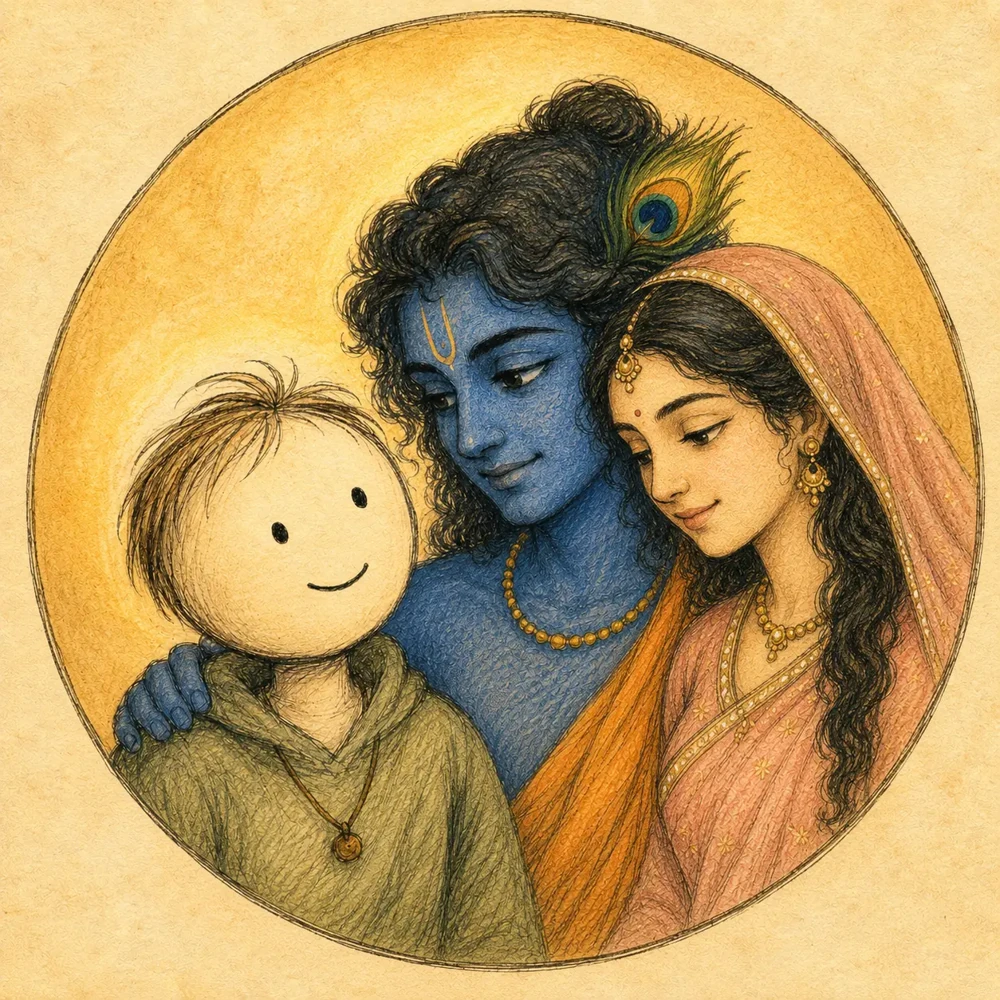

Radha Kripa Kataksh Stotram | Sampurna Path Hindi Mein | Mahadev Ne Likhi Radha Ji Ki Stuti
- Published:
- Updated:
- Reviewed:
- 14 November 2026
Original verse
The original verse is shown in its source language.
Verse 1 — A Merciful Glance Removes Sorrow
Original verse (Devanagari)
मुनीन्द्रवृन्दवन्दिते त्रिलोकशोकहारिणि प्रसन्नवक्त्रपङ्कजे निकुञ्जभूविलासिनि ।
व्रजेन्द्रभानुनन्दिनि व्रजेन्द्रसूनुसङ्गते कदा करिष्यसीह मां कृपाकटाक्षभाजनम् ॥ १ ॥
Transliteration
munīndravṛndavandite trilokaśokahāriṇi prasannavaktrapaṅkaje nikuñjabhūvilāsini | vrajendrabhānunandini vrajendrasūnusaṅgate kadā kariṣyasīha māṃ kṛpākaṭākṣabhājanam || 1 ||
Word-by-word meanings
munīndra-vṛnda — hosts of the greatest sages; vandite — worshipped by; triloka-śoka-hāriṇi — remover of the sorrow of the three worlds; prasanna-vaktra-paṅkaje — whose cheerful face is a lotus; nikuñja-bhū-vilāsini — who delights in the groves; vrajendra-bhānu-nandini — daughter of Vrishabhanu, king of Vraja; vrajendra-sūnu-saṅgate — companion of the son of the lord of Vraja; kadā — when; kariṣyasi — will you make; iha — here; mām — me; kṛpā-kaṭākṣa-bhājanam — a recipient of the merciful sidelong glance.
Translation
O Shri Radhe, even great sages and saints worship Your feet. You remove the sorrow and grief of the three worlds. Your joyful face is as beautiful as a blooming lotus. You enjoy divine pastimes in the honey groves of Vrindavan. You are the beloved daughter of King Vrishabhanu and the eternal companion of Shri Krishna, the son of Nanda, king of Braja. O Kishori ji, when will that blessed moment come when Your merciful sidelong glance falls upon me and I become worthy of Your kripa kataksha?
Explanation
The devotee begins by singing the glory of Shri Radha ji's feet — the feet worshipped by great sages are the same feet that remove the sorrow of all three worlds.
Summary
When the merciful glance of Shri Radha ji falls on someone, the sorrow of the heart begins to melt away.
Verse 2 — Fearlessness at Her Feet
Original verse (Devanagari)
अशोकवृक्षवल्लरीवितानमण्डपस्थिते प्रवालबालपल्लवप्रभारुणाङ्घ्रिकोमले ।
वराभयस्फुरत्करे प्रभूतसम्पदालये कदा करिष्यसीह मां कृपाकटाक्षभाजनम् ॥ २ ॥
Transliteration
aśokavṛkṣavallarīvitānamaṇḍapasthite pravālabālapallavaprabhāruṇāṅghrikomale | varābhayasphuratkare prabhūtasampadālaye kadā kariṣyasīha māṃ kṛpākaṭākṣabhājanam || 2 ||
Word-by-word meanings
aśoka-vṛkṣa-vallarī — creepers of the ashoka tree; vitāna-maṇḍapa-sthite — seated in a canopy-like pavilion; pravāla-bāla-pallava — like coral and fresh young shoots; prabhā-aruṇa-aṅghri-komale — whose feet are tender and rosy with that glow; varābhaya-sphurat-kare — whose hands shine with boon and fearlessness; prabhūta-sampad-ālaye — abode of abundant riches; kadā kariṣyasīha māṃ kṛpā-kaṭākṣa-bhājanam — when will you make me a recipient of your merciful sidelong glance?
Translation
O Shri Radhe, You sit in a beautiful grove-temple made of the creepers of the ashoka tree. Your tender feet are as lovely as fresh red leaves and the redness of coral. Your lotus hands grant boons to devotees and remove the fear from their hearts. You are the infinite store of love, joy, peace and divine wealth. O Sarveshvari, when will You make me worthy of Your merciful glance?
Explanation
The feet of Shri Radha ji are not only beautiful — they remove fear and grant boons. One who comes to Her feet receives fearlessness along with grace.
Summary
A devotee who comes to the feet of Shri Radha ji receives fearlessness along with grace.
Verse 3 — The Glance Full of Love
Original verse (Devanagari)
अनङ्गरङ्गमङ्गलप्रसङ्गभङ्गुरभ्रुवां सविभ्रमं ससम्भ्रमं दृगन्तबाणपातनैः ।
निरन्तरं वशीकृतप्रतीतिनन्दनन्दने कदा करिष्यसीह मां कृपाकटाक्षभाजनम् ॥ ३ ॥
Transliteration
anaṅgaraṅgamaṅgalaprasaṅgabhaṅgurabhruvāṃ savibhramaṃ sasambhramaṃ dṛgantabāṇapātanaiḥ | nirantaraṃ vaśīkṛtapratītinandanandane kadā kariṣyasīha māṃ kṛpākaṭākṣabhājanam || 3 ||
Word-by-word meanings
anaṅga-raṅga-maṅgala-prasaṅga — in the auspicious sport of love; bhaṅgura-bhruvāṃ — with arching brows; savibhramaṃ — playfully; sasambhramaṃ — eagerly; dṛganta-bāṇa-pātanaiḥ — by arrows shot from the corners of the eyes; nirantaram — constantly; vaśīkṛta-pratīti-nanda-nandane — who holds the son of Nanda under her sway; kadā kariṣyasīha māṃ kṛpā-kaṭākṣa-bhājanam — when will you make me a recipient of your merciful sidelong glance?
Translation
In the blessed setting of the Rasa, Shri Radha bends Her brows in a most sweet manner. The glances from Her eyes travel like soft arrows of love. That same loving glance brings even Nanda-nandana Shri Krishna under Her sway. Shyam Sundar, on whom the whole world is enchanted, remains bound in the love of Kishori ji. O Vrindavaneshvari, when will a single ray of Your merciful glance fall upon me?
Explanation
The greatest glory of Kishori ji's love is this: Shri Krishna, who enchants the whole world, is Himself bound by the love of Shri Radha.
Summary
Shri Krishna, who enchants the whole world, is bound by the love of Shri Radha.
Verse 4 — Divine Beauty
Original verse (Devanagari)
तडित्सुवर्णचम्पकप्रदीप्तगौरविग्रहे मुखप्रभापरास्तकोटिशारदेन्दुमण्डले ।
विचित्रचित्रसञ्चरच्चकोरशाबलोचने कदा करिष्यसीह मां कृपाकटाक्षभाजनम् ॥ ४ ॥
Transliteration
taḍitsuvarṇacampakapradīptagauravigrahe mukhaprabhāparāstakoṭiśāradendumaṇḍale | vicitracitrasañcaraccakoraśābalocane kadā kariṣyasīha māṃ kṛpākaṭākṣabhājanam || 4 ||
Word-by-word meanings
taḍit-suvarṇa-campaka-pradīpta-gaura-vigrahe — whose fair form glows like lightning, gold and the champaka flower; mukha-prabhā-parāsta-koṭi-śāradendu-maṇḍale — whose radiant face outshines millions of autumn full moons; vicitra-citra-sañcarac-cakora-śāba-locane — whose eyes dart about like young chakora birds; kadā kariṣyasīha māṃ kṛpā-kaṭākṣa-bhājanam — when will you make me a recipient of your merciful sidelong glance?
Translation
O Shri Radhe, Your divine form shines with the radiance of lightning, gold and the champaka flower. Before the brightness of Your face, crores of autumn full moons fade away. Your restless, love-filled eyes show a fresh and lovely charm every moment, like the young ones of the chakora bird. O Kishori ji, when will the glance of those merciful eyes fall upon me? Make me blessed by Your sidelong glance.
Explanation
The divine beauty of Shri Radha ji appears both in Her form and in Her merciful glance.
Summary
The divine beauty of Shri Radha ji appears in Her form and in Her merciful glance alike.
Verse 5 — Ever-Fresh Youth and Sweet Sulking
Original verse (Devanagari)
मदोन्मदातियौवने प्रमोदमानमण्डिते प्रियानुरागरञ्जिते कलाविलासपण्डिते ।
अनन्यधन्यकुञ्जराज्यकामकेलिकोविदे कदा करिष्यसीह मां कृपाकटाक्षभाजनम् ॥ ५ ॥
Transliteration
madonmadātiyauvane pramodamānamaṇḍite priyānurāgarañjite kalāvilāsapaṇḍite | ananyadhanyakuñjarājyakāmakelikovide kadā kariṣyasīha māṃ kṛpākaṭākṣabhājanam || 5 ||
Word-by-word meanings
madonmadāti-yauvane — in the full bloom of intoxicating youth; pramoda-māna-maṇḍite — adorned with joy and loving pride; priyānurāga-rañjite — coloured by love for her beloved; kalā-vilāsa-paṇḍite — learned in the graceful arts; ananya-dhanya-kuñja-rājya-kāma-keli-kovide — expert in the plays of love in the matchless, blessed kingdom of the groves; kadā kariṣyasīha māṃ kṛpā-kaṭākṣa-bhājanam — when will you make me a recipient of your merciful sidelong glance?
Translation
O Shri Radhe, You dwell in the joy of ever-fresh youth. Your sweet maan (loving sulk) is itself a beautiful ornament of Your love. You are coloured deep in the love of Your beloved Shyam Sundar. You are supremely skilled in every divine art of love in the sweet groves of Vrindavan. Each of Your moods reveals Your boundless love for Shyam Sundar. O Nikunjareshvari, when will You make me worthy of Your merciful glance?
Explanation
The maan of Shri Radha ji is also a form of love — there is no anger in it, only the depth of love. Every mood of Hers is filled with boundless love for Shyam Sundar.
Summary
Every mood of Shri Radha ji is filled with boundless love for Shyam Sundar.
Verse 6 — Graceful Moods and the Sweet Smile
Original verse (Devanagari)
अशेषहावभावधीरहीरहारभूषिते प्रभूतशातकुम्भकुम्भकुम्भिकुम्भसुस्तनि ।
प्रशस्तमन्दहास्यचूर्णपूर्णसौख्यसागरे कदा करिष्यसीह मां कृपाकटाक्षभाजनम् ॥ ६ ॥
Transliteration
aśeṣahāvabhāvadhīrahīrahārabhūṣite prabhūtaśātakumbhakumbhakumbhikumbhasustani | praśastamandahāsyacūrṇapūrṇasaukhyasāgare kadā kariṣyasīha māṃ kṛpākaṭākṣabhājanam || 6 ||
Word-by-word meanings
aśeṣa-hāva-bhāva-dhīra-hīra-hāra-bhūṣite — adorned with every graceful gesture and feeling, as with a necklace of fine diamonds; prabhūta-śāta-kumbha-kumbha-kumbhi-kumbha-sustani — whose form is likened to pots of pure gold; praśasta-manda-hāsya-cūrṇa-pūrṇa-saukhya-sāgare — an ocean of happiness filled with the fragrant powder of the gentle smile; kadā kariṣyasīha māṃ kṛpā-kaṭākṣa-bhājanam — when will you make me a recipient of your merciful sidelong glance?
Translation
O Shri Radhe, You are adorned with all divine graceful moods and sweet ornaments. You wear a necklace of diamonds that is patience itself. Your fair complexion shines like pure gold. Your divine form is as lovely as golden pots, full of beauty. Your gentle smile is like an ocean of boundless joy. Even remembering that smile fills the devotee's empty heart with happiness. O Krishna-priya, when will I receive the grace of that sweet smile?
Explanation
The smile of Kishori ji is not mere beauty — it is an ocean of joy. Even remembering it fills an empty heart with happiness.
Summary
The sweet smile of Kishori ji fills the devotee's heart with joy.
Verse 7 — Tender Arms and Restless Eyes
Original verse (Devanagari)
मृणालवालवल्लरी तरङ्गरङ्गदोर्लते लताग्रलास्यलोलनीललोचनावलोकने ।
ललल्लुलन्मिलन्मनोज्ञमुग्धमोहनाश्रिते कदा करिष्यसीह मां कृपाकटाक्षभाजनम् ॥ ७ ॥
Transliteration
mṛṇālavālavallarī taraṅgaraṅgadorlate latāgralāsyalolanīlalocanāvalokane | lalallulanmilanmanojñamugdhamohanāśrite kadā kariṣyasīha māṃ kṛpākaṭākṣabhājanam || 7 ||
Word-by-word meanings
mṛṇāla-vāla-vallarī — like young lotus stalks; taraṅga-raṅga-dor-late — whose creeper-like arms sway on the waves; latāgra-lāsya-lola-nīla-locanāvalokane — whose dark restless eyes dance like the tips of vines; lalal-lulan-milan-manojña-mugdha-mohanāśrite — charming one, sought as refuge by the enchanted Mohana; kadā kariṣyasīha māṃ kṛpā-kaṭākṣa-bhājanam — when will you make me a recipient of your merciful sidelong glance?
Translation
O beloved daughter of Vrishabhanu, Your tender arms are as beautiful as lotus stalks swaying on the waves of water. Your deep, restless eyes look like the tip of a creeper slowly dancing at the touch of the wind. Every glance of Yours is filled with shyness, playfulness and sweet love. Shyam Sundar, who enchants the minds of the whole world, remains enchanted by Your form and love. You alone give shelter in Your love to that Manmohana. O Kishori ji, when will You give me the shelter of Your grace?
Explanation
The grace of Shri Radha — on whom even Manmohana is enchanted — is the supreme shelter of the devotee.
Summary
The grace of Shri Radha, on whom even Manmohana is enchanted, is the devotee's supreme shelter.
Verse 8 — The Neck and the Hair
Original verse (Devanagari)
सुवर्णमालिकाञ्चितत्रिरेखकम्बुकण्ठगे त्रिसूत्रमङ्गलीगुणत्रिरत्नदीप्तिदीधिते ।
सलोलनीलकुन्तलप्रसूनगुच्छगुम्फिते कदा करिष्यसीह मां कृपाकटाक्षभाजनम् ॥ ८ ॥
Transliteration
suvarṇamālikāñcitatrirekhakambukaṇṭhage trisūtramaṅgalīguṇatriratnadīptidīdhite | salolanīlakuntalaprasūnagucchagumphite kadā kariṣyasīha māṃ kṛpākaṭākṣabhājanam || 8 ||
Word-by-word meanings
suvarṇa-mālikāñcita-trirekha-kambu-kaṇṭhage — whose conch-like neck with its three lines is graced by a golden necklace; tri-sūtra-maṅgalī-guṇa-tri-ratna-dīpti-dīdhite — shining with an auspicious three-stranded cord set with three gems; salola-nīla-kuntala-prasūna-guccha-gumphite — whose dark flowing locks are braided with clusters of flowers; kadā kariṣyasīha māṃ kṛpā-kaṭākṣa-bhājanam — when will you make me a recipient of your merciful sidelong glance?
Translation
O Shri Radhe, Your neck, beautiful like a conch, is adorned with three lovely lines. Gold necklaces and divine ornaments studded with jewels shine on Your neck, and their light spreads all around. Your dark, curly, playful hair is woven with beautiful clusters of flowers. This divine adornment reveals Your incomparable sweetness even more. O daughter of Kirti, when will You bless me with Your merciful glance?
Explanation
Every ornament of Shri Radha ji reveals the beauty of Her divine sweetness.
Summary
Every ornament of Shri Radha ji reveals the beauty of Her divine sweetness.
Verse 9 — The Waist and the Thighs
Original verse (Devanagari)
नितम्बबिम्बलम्बमानपुष्पमेखलागुणे प्रशस्तरत्नकिङ्किणीकलापमध्यमञ्जुले ।
करीन्द्रशुण्डदण्डिकावरोहसौभगोरुके कदा करिष्यसीह मां कृपाकटाक्षभाजनम् ॥ ९ ॥
Transliteration
nitambabimbalambamānapuṣpamekhalāguṇe praśastaratnakiṅkiṇīkalāpamadhya mañjule | karīndraśuṇḍadaṇḍikāvarohasaubhagoruke kadā kariṣyasīha māṃ kṛpākaṭākṣabhājanam || 9 ||
Word-by-word meanings
nitamba-bimba-lambamāna-puṣpa-mekhalā-guṇe — whose rounded hips carry a hanging girdle of flowers; praśasta-ratna-kiṅkiṇī-kalāpa-madhya-mañjule — lovely with a string of fine jewelled bells; karīndra-śuṇḍa-daṇḍikā-varoha-saubhaga-oruke — whose graceful thighs taper like the trunk of a lordly elephant; kadā kariṣyasīha māṃ kṛpā-kaṭākṣa-bhājanam — when will you make me a recipient of your merciful sidelong glance?
Translation
O daughter of Braja, a beautiful girdle of flowers adorns Your waist. Small jewel-studded bells tinkle sweetly. Your entire divine form is most tender and lovely. Your beautiful, well-formed thighs are compared to the trunk of the royal elephant. O Shri Radhe, when will You make me worthy of Your merciful glance?
Explanation
In this verse the devotee worships Your divine form and sweet adornment with love, and makes only one prayer — make me worthy of Your merciful glance.
Summary
This verse lovingly worships the divine form and sweet adornment of Shri Radha ji.
Verse 10 — The Sound of the Anklets
Original verse (Devanagari)
अनेकमन्त्रनादमञ्जुनूपुरारवस्खलत्समाजराजहंसवंशनिक्वणातिगौरवे ।
विलोलहेमवल्लरीविडम्बचारुचङ्क्रमे कदा करिष्यसीह मां कृपाकटाक्षभाजनम् ॥ १० ॥
Transliteration
anekamantranādamañjunūpurāravaskhalatsamājarājahaṃsavaṃśanikvaṇātigaurave | vilolahemavallarīviḍambacārucaṅkrame kadā kariṣyasīha māṃ kṛpākaṭākṣabhājanam || 10 ||
Word-by-word meanings
aneka-mantra-nāda-mañju-nūpurā-rava-skhalat — whose sweet anklets chime like the sound of many mantras; samāja-rāja-haṃsa-vaṃśa-nikvaṇāti-gaurave — surpassing in grace the calls of a flock of royal swans; vilola-hema-vallarī-viḍambi-cāru-caṅkrame — whose lovely gait mocks a swaying golden creeper; kadā kariṣyasīha māṃ kṛpā-kaṭākṣa-bhājanam — when will you make me a recipient of your merciful sidelong glance?
Translation
O Shri Radhe, the sweet sound from the anklets on Your feet seems like the echo of many sacred mantras. That melodious tinkling surpasses even the sweet speech of royal swans. When You walk slowly through the grove lanes of Braja, Your divine form appears like a swaying golden creeper. Your gait and the sound of Your anklets fill the whole of Braja with sweetness. O Jagadishvari, when will the memory of Your feet dwell in my heart?
Explanation
The movement of Shri Radha ji's feet and the sound of Her anklets fill the whole of Braja with sweetness.
Summary
The movement of Shri Radha ji's feet and the sound of Her anklets fill the whole of Braja with sweetness.
Verse 11 — Feet Worshipped by Goddesses
Original verse (Devanagari)
अनन्तकोटिविष्णुलोकनम्रपद्मजार्चिते हिमाद्रिजापुलोमजाविरिञ्चजावरप्रदे ।
अपारसिद्धिऋद्धिदिग्धसत्पदाङ्गुलीनखे कदा करिष्यसीह मां कृपाकटाक्षभाजनम् ॥ ११ ॥
Transliteration
anantakoṭiviṣṇulokanamrapadmajārcite himādrijāpulomajāviriñcajāvaraprade | apārasiddhiṛddhidigdhasatpadāṅgulīnakhe kadā kariṣyasīha māṃ kṛpākaṭākṣabhājanam || 11 ||
Word-by-word meanings
ananta-koṭi-viṣṇu-loka-namra-padmajārcite — worshipped by Brahma and bowed to in countless millions of worlds of Vishnu; himādrijā-pulomajā-viriñcajā-vara-prade — who grants boons to Parvati, to Shachi the daughter of Puloma, and to Saraswati; apāra-siddhi-ṛddhi-digdha-sat-padāṅgulī-nakhe — whose holy toenails are anointed with boundless powers and prosperity; kadā kariṣyasīha māṃ kṛpā-kaṭākṣa-bhājanam — when will you make me a recipient of your merciful sidelong glance?
Translation
O Shri Radhe, even Shri Lakshmi ji, the mistress of infinite crores of Vaikunthas, worships You. Parvati ji, Indrani ji and Saraswati ji worshipped Your feet and received boons. By meditating even on the nail of one toe of Your lotus feet, one attains immense perfection and divine wealth. The feet worshipped by great goddesses are the same feet from which this small devotee begs for grace. O merciful Mother, when will You bless me with Your glance of compassion?
Explanation
The feet worshipped by goddesses are the feet from which the devotee begs for a single glance of grace.
Summary
The feet worshipped by goddesses are the feet from which the devotee begs for a single glance of grace.
Verse 12 — Mistress of the Whole World
Original verse (Devanagari)
मखेश्वरि क्रियेश्वरि स्वधेश्वरि सुरेश्वरि त्रिवेदभारतीश्वरि प्रमाणशासनेश्वरि ।
रमेश्वरि क्षमेश्वरि प्रमोदकाननेश्वरि व्रजेश्वरि व्रजाधिपे श्रीराधिके नमोऽस्तु ते ॥ १२ ॥
Transliteration
makheśvari kriyeśvari svadheśvari sureśvari trivedabhāratīśvari pramāṇaśāsaneśvari | rameśvari kṣameśvari pramodakānaneśvari vrajeśvari vrajādhipe śrīrādhike namo'stu te || 12 ||
Word-by-word meanings
makheśvari — queen of sacrifices; kriyeśvari — queen of sacred rites; svadheśvari — queen of offerings to the ancestors; sureśvari — queen of the gods; triveda-bhāratīśvari — queen of the speech of the three Vedas; pramāṇa-śāsaneśvari — queen of right knowledge and its rule; rameśvari — queen of Lakshmi; kṣameśvari — queen of patience; pramoda-kānaneśvari — queen of the forest of delight; vrajeśvari — queen of Vraja; vrajādhipe — ruler of Vraja; śrī rādhike — O Sri Radhika; namo'stu te — salutations to you.
Translation
O Shri Radhe, You are the mistress of all yajnas. You are the mistress of all auspicious deeds and actions. You are the mistress even of the gods. The knowledge, wisdom, authority and rule of the three Vedas are under You. You are the mistress of Lakshmi ji. You are the mistress of forgiveness. You are the mistress of the joy-filled pramoda-kanana of Vrindavan. O Brajesvari, O presiding goddess of the whole of Braja, Shri Radhike, my repeated salutations at Your feet.
Explanation
Shri Radha, the mistress of the whole world, dwells as the beloved young girl of Braja out of love.
Summary
Shri Radha, the mistress of the whole world, dwells as the beloved young girl of Braja out of love.
Verse 13 — The Prayer for the Merciful Glance
Original verse (Devanagari)
इती ममाद्भुतं स्तवं निशम्य भानुनन्दिनी करोतु सन्ततं जनं कृपाकटाक्षभाजनम् ।
भवेत्तदैव सञ्चितत्रिरूपकर्मनाशनं भवेत्तदा व्रजेन्द्रसूनुमण्डलप्रवेशनम् ॥ १३ ॥
Transliteration
itī mamādbhutaṃ stavaṃ niśamya bhānunandinī karotu santataṃ janaṃ kṛpākaṭākṣabhājanam | bhavet tadaiva sañcitatrirūpakārmanāśanaṃ bhavet tadā vrajendrasūnumaṇḍalapraveśanam || 13 ||
Word-by-word meanings
itī — thus; mama — my; adbhutaṃ stavaṃ — wondrous hymn; niśamya — on hearing; bhānu-nandinī — O daughter of Vrishabhanu; karotu — may (she) make; santatam — for ever; janam — this person; kṛpā-kaṭākṣa-bhājanam — a recipient of her merciful sidelong glance; bhavet tadaiva — at once there will be; sañcita-tri-rūpa-karma-nāśanaṃ — destruction of stored karma of all three kinds; bhavet tadā — then there will be; vrajendra-sūnu-maṇḍala-praveśanam — entrance into the circle of the son of the lord of Vraja.
Translation
O daughter of Vrishabhanu, hearing this wonderful hymn of praise, make me, Your servant, forever worthy of Your kripa kataksha. By Your mercy alone can the three kinds of karma of a living being — prarabdha, sanchita and kriyamana — be destroyed. By Your grace alone can one enter the eternal loving retinue of Nanda-nandana Shri Krishna and His divine pastimes.
Explanation
The grace of Shri Radha ji frees the soul from the bondage of karma and carries it to the eternal pastimes of Shyam Sundar.
Summary
The grace of Shri Radha ji frees the soul from the bondage of karma and carries it to the eternal pastimes of Shyam Sundar.
Phalaśruti — Verse 14 — Recitation on Holy Days
Original verse (Devanagari)
राकायां च सिताष्टम्यां दशम्यां च विशुद्धधीः ।
एकादश्यां त्रयोदश्यां यः पठेत्साधकः सुधीः ॥ १४ ॥
Transliteration
rākāyāṃ ca sitāṣṭamyāṃ daśamyāṃ ca viśuddhadhīḥ | ekādaśyāṃ trayodaśyāṃ yaḥ paṭhet sādhakaḥ sudhīḥ || 14 ||
Word-by-word meanings
rākāyām — on the full-moon day; ca — and; sitāṣṭamyām — on the eighth day of the bright fortnight; daśamyām — on the tenth day; ca — and; viśuddha-dhīḥ — of pure mind; ekādaśyām — on the eleventh day; trayodaśyām — on the thirteenth day; yaḥ — who; paṭhet — recites; sādhakaḥ — the seeker; sudhīḥ — the wise one.
Translation
One who recites this stotram with a pure intellect and a steady mind — on the day of Purnima, or on the Ashtami of the bright fortnight, or on Dashami, Ekadashi or Trayodashi — gains special fruit from this recitation. Recitation done with a pure heart on these holy days leads the seeker towards the grace of Kishori ji.
Explanation
Recitation done with a pure heart on a holy day is a special means of receiving the grace of Shri Radha ji.
Summary
Recitation done with a pure heart on a holy day is a special means of receiving the grace of Shri Radha ji.
Phalaśruti — Verse 15 — Devotion Marked by Love
Original verse (Devanagari)
यं यं कामयते कामं तं तमाप्नोति साधकः ।
राधाकृपाकटाक्षेण भक्तिः स्यात् प्रेमलक्षणा ॥ १५ ॥
Transliteration
yaṃ yaṃ kāmayate kāmaṃ taṃ tam āpnoti sādhakaḥ | rādhākṛpākaṭākṣeṇa bhaktiḥ syāt premalakṣaṇā || 15 ||
Word-by-word meanings
yaṃ yaṃ — whatever; kāmayate — he desires; kāmaṃ — desire; taṃ tam — that very thing; āpnoti — he obtains; sādhakaḥ — the seeker; rādhā-kṛpā-kaṭākṣeṇa — by the merciful sidelong glance of Radha; bhaktiḥ — devotion; syāt — arises; prema-lakṣaṇā — whose mark is pure love.
Translation
One who recites this stotram with faith and a pure heart finds his desires fulfilled. But an even greater fruit is described next — by the merciful kripa kataksha of Shri Radha, prema-lakshana bhakti awakens in the seeker's heart. Such devotion is recognised by true love, in which there is no show and no selfishness — only the desire to please one's beloved Lord remains.
Explanation
Greater than the fulfilment of desires is the awakening of loving devotion in the heart.
Summary
Greater than the fulfilment of desires is the awakening of loving devotion in the heart.
Phalaśruti — Verse 16 — Recitation in Radha Kund
Original verse (Devanagari)
ऊरुदघ्ने नाभिदघ्ने हृद्दघ्ने कण्ठदघ्नके ।
राधाकुण्डजले स्थिता यः पठेत् साधकः शतम् ॥ १६ ॥
Transliteration
ūrudaghne nābhidaghne hṛddaghne kaṇṭhadaghnake | rādhākuṇḍajale sthitā yaḥ paṭhet sādhakaḥ śatam || 16 ||
Word-by-word meanings
ūru-daghne — up to the thighs; nābhi-daghne — up to the navel; hṛd-daghne — up to the chest; kaṇṭha-daghnake — up to the neck; rādhā-kuṇḍa-jale — in the waters of Radha Kunda; sthitā — standing; yaḥ — who; paṭhet — recites; sādhakaḥ — the seeker; śatam — a hundred times.
Translation
This verse describes the special method of recitation in the holy waters of Shri Radha Kund. One who stands in the water of Shri Radha Kund — up to the knees, the navel, the heart or the neck — and recites this stotram 100 times is described in the next verse as receiving special fruits. This is said to be a special practice for receiving the grace of Shri Radha.
Explanation
Recitation done in Shri Radha Kund is described as a special practice for receiving the grace of Kishori ji.
Summary
Recitation done in Shri Radha Kund is described as a special practice for receiving the grace of Kishori ji.
Phalaśruti — Verse 17 — The Four Goals and Darshan
Original verse (Devanagari)
तस्य सर्वार्थसिद्धिः स्याद् वाक्सामर्थ्यं तथा लभेत् ।
ऐश्वर्यं च लभेत् साक्षाद्दृशा पश्यति राधिकाम् ॥ १७ ॥
Transliteration
tasya sarvārthasiddhiḥ syād vāksāmarthyaṃ tathā labhet | aiśvaryaṃ ca labhet sākṣād dṛśā paśyati rādhikām || 17 ||
Word-by-word meanings
tasya — for him; sarvārtha-siddhiḥ — perfection of every aim; syāt — there is; vāk-sāmarthyaṃ — power of speech; tathā — and; labhet — he gains; aiśvaryam — lordly splendour; ca — and; labhet — he gains; sākṣāt — directly; dṛśā — with his own eyes; paśyati — he sees; rādhikām — Radhika.
Translation
Such a seeker attains perfection in all four goals of life — dharma, artha, kama and moksha. His speech gains special power. He receives divine opulence. And the most incomparable fruit described is that he is blessed with the direct darshan of Shrimati Radhika ji. Beyond all the attainments of the world, the darshan of Kishori ji is the devotee's greatest wealth.
Explanation
Among all attainments, the most incomparable fruit is the direct darshan of Shrimati Radhika ji.
Summary
Among all attainments, the most incomparable fruit is the direct darshan of Shrimati Radhika ji.
Phalaśruti — Verse 18 — Darshan of Shyam Sundar
Original verse (Devanagari)
तेन स तत्क्षणादेव तुष्टा दत्ते महावरम् ।
येन पश्यति नेत्राभ्यां तत् प्रियं श्यामसुन्दरम् ॥ १८ ॥
Transliteration
tena sa tatkṣaṇād eva tuṣṭā datte mahāvaram | yena paśyati netrābhyāṃ tat priyaṃ śyāmasundaram || 18 ||
Word-by-word meanings
tena — by that; sā — she; tat-kṣaṇād eva — at that very moment; tuṣṭā — pleased; datte — grants; mahā-varam — a great boon; yena — by which; paśyati — he sees; netrābhyām — with his own eyes; tat-priyaṃ — her beloved; śyāmasundaram — Shyamasundara.
Translation
When Shrimati Radhika ji is pleased with the devotion of the seeker, She grants him a great boon — the direct darshan of Her most beloved Shyam Sundar. There is a most loving sentiment here — Shri Radha ji carries Her devotee to Her beloved Shyam Sundar. One whom Kishori ji accepts, She does not leave deprived of the grace of Her beloved Shyam Sundar either.
Explanation
The grace of Shri Radha ji carries the seeker to the darshan of Her beloved Shyam Sundar.
Summary
The grace of Shri Radha ji carries the seeker to the darshan of Her beloved Shyam Sundar.
Phalaśruti — Verse 19 — Entry into the Eternal Pastimes
Original verse (Devanagari)
नित्यलीलाप्रवेशं च ददाति श्रीव्रजाधिपः ।
अतः परतरं प्रार्थ्यं वैष्णवस्य न विद्यते ॥ १९ ॥
Transliteration
nityalīlāpraveśaṃ ca dadāti śrīvrajādhipaḥ | ataḥ parataraṃ prārthyaṃ vaiṣṇavasya na vidyate || 19 ||
Word-by-word meanings
nitya-līlā-praveśaṃ — entrance into the eternal pastimes; ca — and; dadāti — grants; śrī-vrajādhipaḥ — the Lord of Vraja; ataḥ — than this; parataraṃ — higher; prārthyaṃ — to be prayed for; vaiṣṇavasya — for a Vaishnava; na — not; vidyate — there is.
Translation
This final verse describes the highest fruit of the stotram. After this, Shyam Sundar grants the seeker entry into His eternal loving pastimes and everlasting divine play. This is the supreme goal of the devotee's journey. Not wealth, not fame, not any worldly attainment — only a place in the eternal loving pastimes of Shri Radha-Shyam. For a true Vaishnava, nothing remains worth asking beyond this.
Explanation
The supreme fruit of devotion is entry into the eternal loving pastimes of Shri Radha-Shyam.
Summary
The supreme fruit of devotion is entry into the eternal loving pastimes of Shri Radha-Shyam.
Greatness of the hymn
The greatness of the Shri Radha Kripa Kataksh Stotram is that in it the devotee makes no claim of any merit of his own — he asks for only one boon, the merciful glance of Kishori ji. And by that single glance, sorrow is removed, the bonds of karma are cut, loving devotion awakens in the heart, and the devotee reaches the eternal pastimes of Shyam Sundar. This hymn, composed by Mahadeva ji, tells us that even Lord Shiva worships the feet of Shri Radha ji.
How to recite
Sit calmly, in the morning or evening, before a picture of Shri Radha ji and recite this stotram. Purnima, and the Ashtami, Dashami, Ekadashi or Trayodashi of the bright fortnight, are said to carry special fruit. Recite each verse slowly, keeping its meaning in the heart, and at the end pray to Kishori ji for Her merciful glance.
Prayer
O daughter of Vrishabhanu, O merciful Mother, make me, Your servant, forever worthy of Your kripa kataksha. Remove my sorrow, cut the bonds of my karma, and awaken in my heart loving devotion for Your beloved Shyam Sundar.
Source: Shri Radha Kripa Kataksh Stotram, composed by Mahadeva ji, traditional text. Original verses — the traditional Vrindavan text (Urdhvamnaya Tantra), verified at https://astrobhava.com/mantra/radha-kripa-kataksh-stotra/ · https://gitaforchildren.com/happy-radhashtami-radha-kripa-kataksha-stotra/ · https://hindugallery.com/sri-radha-krupa-kataksha-stotram/ · https://vedics.in/radha-kripa-kataksh-stotra-in-hindi-english-and-sanskrit/ . Note: the sanskritdocuments.org text differs in the phalashruti (verses 14–16, 19) and does not match the video's meanings, so it was not used — https://sanskritdocuments.org/doc_devii/rAdhAkRRipAkaTAkShastavarAjaH.itx
Radhe Radhe 🙏
If this simple meaning brought you even a little closer to Shri Radha ji, please write with love in the comments — Jai Jai Shri Radhe. And tell us in one line: which worry are you leaving at the feet of Kishori ji today? Or tell us what beautiful change the grace of Radha Rani has brought into your life — your experience may awaken hope in the heart of someone sad or worried. Share this video on WhatsApp with a dear one who is passing through worry, sorrow or difficulty right now, so that this sweet prayer of Shri Radha's kripa kataksha reaches their heart too, and Kishori ji keeps Her merciful grace upon them. On Radha Krishna Vani we share the meanings of such beautiful hymns in simple language. To stay connected, subscribe to the channel and press the bell. Jai Jai Shri Radhe. Jai Jai Shri Harivansh.
Spotted an error? Please tell us in a YouTube comment. Watch on YouTube
Related videos
 16:47
Stotra
Gajendra Moksha Stotra Arth Sahit | Hindi Meaning, Bhavarth & Saar
 12:51
Stotra
Shri Suktam Meaning in Hindi | श्रीसूक्त का सम्पूर्ण सरल हिन्दी अर्थ, भावार्थ और सार
 24:30
Stotra
Shri Hanuman Bahuk in Hindi | हनुमान बाहुक अर्थ सहित | सम्पूर्ण 44 छंद
 10:50
Stotra